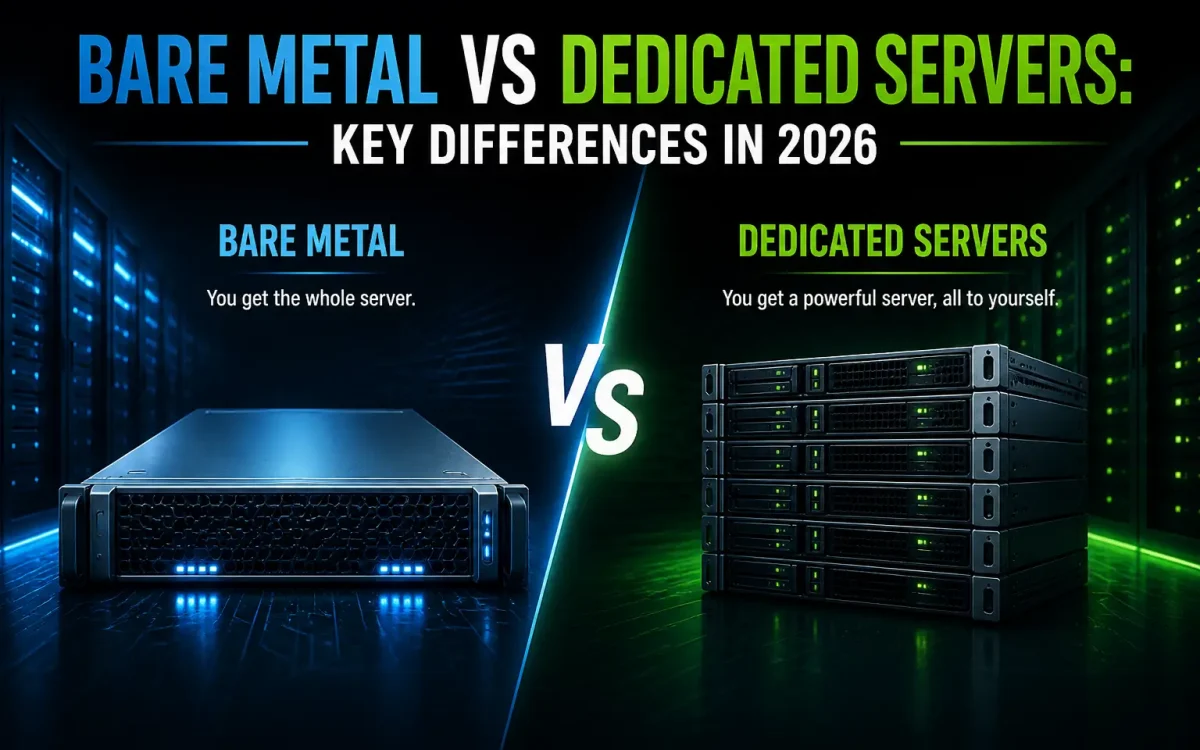
right server infrastructure becomes critical. Two of the most powerful hosting options available today are bare metal servers and dedicated servers. While both provide full access to physical hardware, they differ significantly in how they are deployed, managed, and scaled. In this guide, we break down the key differences between bare metal and dedicated servers, helping you choose the best solution for your business or project.
What Is a Dedicated Server
A dedicated server is a physical machine exclusively assigned to a single user or organization. This means there are no shared resources, you have full control over the server, and performance remains stable and predictable. Dedicated servers are commonly used for business websites, hosting providers, databases, and web applications. The main advantage of dedicated servers is consistency and control, making them ideal for workloads that do not change frequently.
What Is a Bare Metal Server
A bare metal server is also a physical server, but it is typically delivered as part of a modern, cloud-like infrastructure. Unlike traditional dedicated servers, bare metal servers are designed for rapid provisioning, often within minutes, and include API-based management, integration with cloud platforms, and high flexibility. They are widely used in AI workloads, high-performance computing, SaaS platforms, and large-scale applications. The key difference is not the hardware itself, but how it is deployed and managed.
Key Differences Between Bare Metal and Dedicated Servers
The main difference lies in flexibility and management. Dedicated servers follow a traditional model with slower provisioning and more manual control, while bare metal servers are designed for automation, speed, and scalability. Dedicated servers are typically provisioned manually and used for long-term workloads, while bare metal servers can be deployed quickly and integrated into modern cloud environments with API-driven management and infrastructure automation.
Performance and Scalability
Both bare metal and dedicated servers deliver excellent performance because they provide full access to physical hardware with no resource sharing and no virtualization overhead. This makes them ideal for high-performance workloads. However, bare metal servers often have an advantage in modern environments due to better integration with NVMe storage, advanced networking, and optimized deployment systems. When it comes to scalability, dedicated servers usually require manual upgrades or migration to a new server, which can take time. Bare metal servers, on the other hand, allow rapid provisioning of additional servers and integration with cloud scaling systems, making them far more flexible for growing applications.
Pricing and Use Cases
Dedicated servers are best suited for stable workloads and long-term projects where traffic is predictable. They offer fixed monthly pricing, making them cost-effective and easier to manage over time. Bare metal servers are better suited for high-growth projects, scalable applications, SaaS platforms, and data-intensive workloads. They provide flexibility and fast deployment, but costs can increase depending on usage and scaling needs. Choosing between the two often depends on whether you prioritize cost stability or scalability.
When Should You Choose Each
You should choose a dedicated server if you need stable performance, predictable traffic handling, fixed pricing, and a simpler infrastructure. Dedicated servers are ideal for traditional business websites and long-term hosting environments. You should choose a bare metal server if your project is growing rapidly, requires automation, needs API access, or must handle unpredictable traffic spikes. Bare metal servers are designed for modern applications that require flexibility and scalability.
Final Verdict
Bare metal vs dedicated servers in 2026 ultimately comes down to your workload and growth expectations. Dedicated servers are ideal for businesses that need stability, consistent performance, and predictable costs. Bare metal servers are better suited for projects that require scalability, automation, and fast deployment. If your project is traditional and stable, a dedicated server is a reliable choice. If your project is modern, growing, and performance-driven, bare metal infrastructure offers greater flexibility and long-term advantages.
Further Reading
For an authoritative reference on this topic, see Cloudflare — Storage and SSD Performance.
Looking for fast, secure hosting?
Visit UK Speed for cloud servers, VPS NVMe, and dedicated hosting tailored for performance.