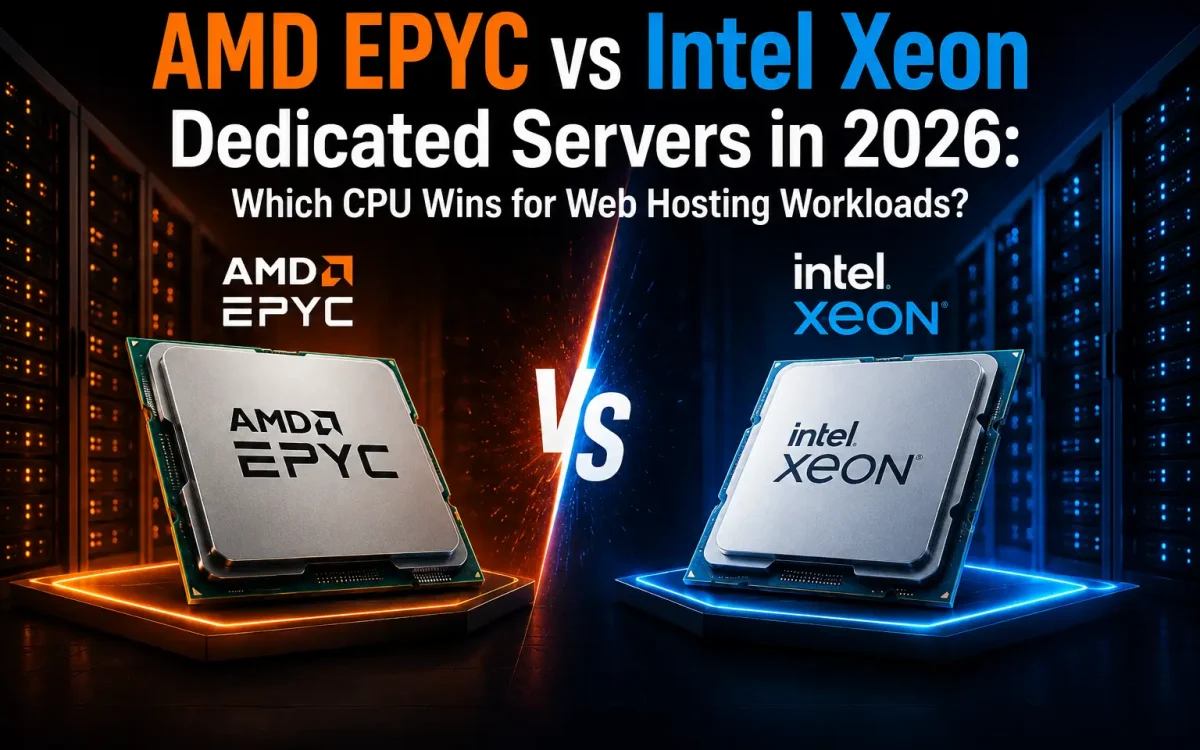
Choosing the right dedicated server CPU has never been more important. As websites become more dynamic, databases grow larger, virtualization becomes standard, and AI-powered applications demand greater computing resources, server performance directly impacts business success.
For more than two decades, Intel Xeon dominated the dedicated server market. However, AMD EPYC has dramatically changed the landscape, delivering impressive gains in core density, power efficiency, memory bandwidth, and virtualization performance.
In 2026, hosting providers, cloud operators, SaaS companies, and enterprise organizations are asking a critical question:
Should you choose AMD EPYC or Intel Xeon for modern web hosting workloads?
In this comprehensive comparison, we’ll examine architecture, performance, virtualization capabilities, power efficiency, scalability, and real-world hosting workloads to determine which platform offers the best value for dedicated servers in 2026.
Why CPU Choice Matters for Web Hosting
The processor is the foundation of every dedicated server.
Whether you’re hosting:
- WordPress websites
- WooCommerce stores
- cPanel servers
- Cloud hosting platforms
- VPS infrastructure
- Database clusters
- Email servers
- SaaS applications
- AI workloads
CPU performance affects:
- Page load speed
- Database response times
- Virtual machine density
- Application performance
- Resource utilization
- Power consumption
- Overall hosting profitability
Selecting the wrong platform can lead to higher operational costs and lower performance.
The State of Server CPUs in 2026
The server CPU market is now dominated by two major competitors:
AMD EPYC
AMD’s EPYC 9004 and EPYC 9005 series continue to gain market share due to:
- High core counts
- Massive cache capacity
- Strong virtualization performance
- Excellent performance-per-watt
- Competitive pricing
Popular hosting CPUs include:
- AMD EPYC 9355
- AMD EPYC 9555
- AMD EPYC 9655
- AMD EPYC 9755
Intel Xeon
Intel’s latest Xeon Scalable processors remain popular in enterprise environments and certain specialized workloads.
Popular models include:
- Xeon Silver Series
- Xeon Gold Series
- Xeon Platinum Series
- Xeon 6 Performance Cores
Intel continues focusing on:
- Enterprise integrations
- AI acceleration
- Security features
- Legacy ecosystem compatibility
AMD EPYC Architecture Advantages
One reason hosting providers increasingly adopt EPYC servers is AMD’s chiplet architecture.
Benefits include:
Higher Core Density
Modern EPYC processors can provide:
- 32 cores
- 64 cores
- 96 cores
- 128 cores
- 192 cores
within a single CPU socket.
This allows providers to host more virtual machines and customers on fewer servers.
Large L3 Cache
Many web hosting workloads benefit significantly from larger cache sizes.
Examples include:
- MySQL databases
- MariaDB servers
- Redis caching
- Object caching
- WordPress hosting
Larger cache reduces memory access latency and improves responsiveness.
Massive PCIe Connectivity
EPYC processors support large numbers of PCIe lanes.
This enables:
- Multiple NVMe drives
- High-speed networking
- GPU expansion
- Storage scalability
without performance bottlenecks.
Intel Xeon Architecture Advantages
Intel Xeon remains a strong contender in several areas.
Mature Enterprise Ecosystem
Many enterprises have built infrastructure around Xeon for years.
Benefits include:
- Extensive vendor support
- Certified software stacks
- Long-term deployment familiarity
Strong Single-Core Performance
Certain Xeon models offer excellent single-thread performance.
This can benefit:
- Legacy applications
- Older CMS platforms
- Single-threaded workloads
Specialized Features
Intel offers:
- QuickAssist Technology (QAT)
- Advanced encryption acceleration
- AI acceleration engines
- Enterprise security features
These capabilities can benefit specific enterprise deployments.
AMD EPYC vs Intel Xeon: Core Count Comparison
One of the most important differences is core density.
Typical AMD EPYC Hosting CPUs
| CPU | Cores | Threads |
|---|---|---|
| EPYC 9355 | 32 | 64 |
| EPYC 9555 | 64 | 128 |
| EPYC 9655 | 96 | 192 |
| EPYC 9755 | 128 | 256 |
Typical Intel Xeon Hosting CPUs
| CPU | Cores | Threads |
|---|---|---|
| Xeon Gold | 32–56 | 64–112 |
| Xeon Platinum | 48–72 | 96–144 |
| Xeon 6 | Up to 144 | Variable |
For virtualization and cloud hosting, higher core density often translates directly into greater profitability.
Virtualization Performance
Modern hosting environments rely heavily on virtualization.
Common platforms include:
- Proxmox VE
- VMware
- Hyper-V
- KVM
- OpenStack
Why EPYC Excels
EPYC processors provide:
- Higher VM density
- Larger memory capacity
- More PCIe lanes
- Better performance-per-core
Hosting providers frequently deploy hundreds of VPS instances on a single EPYC server.
Intel Xeon Performance
Xeon remains highly capable, especially in enterprise virtualization environments.
However, AMD often delivers better VM density per dollar.
For VPS hosting providers, this can significantly impact revenue generation.
Web Hosting Benchmarks
When comparing web hosting workloads, several factors matter:
Apache and Nginx Performance
AMD EPYC generally delivers:
- Higher concurrent request handling
- Better scalability under heavy traffic
- Lower response times during peak loads
PHP Processing
Modern PHP workloads benefit from:
- Large caches
- Fast memory
- Multiple cores
EPYC’s architecture often provides measurable advantages.
WordPress Hosting
WordPress powers a large portion of the internet.
Hosting benchmarks commonly show:
- Faster database queries
- Better WooCommerce performance
- Higher user concurrency
on modern EPYC platforms.
Database Performance
Databases are frequently the bottleneck in hosting environments.
MySQL and MariaDB
EPYC CPUs excel due to:
- Large L3 cache
- Memory bandwidth
- High core counts
This improves:
- Query execution
- Concurrent connections
- Transaction throughput
PostgreSQL
PostgreSQL also benefits from EPYC’s architecture, particularly in large-scale deployments.
Power Efficiency and Operating Costs
Data centers care about more than raw performance.
Power consumption directly impacts profitability.
AMD EPYC Efficiency
EPYC processors often deliver:
- Higher performance-per-watt
- Better rack density
- Reduced cooling requirements
This can lower long-term operational costs.
Intel Xeon Efficiency
Intel continues improving efficiency, but AMD frequently maintains an advantage in performance-per-watt comparisons.
For hosting companies operating dozens or hundreds of servers, these savings become substantial.
Storage Performance and PCIe Lanes
Modern hosting increasingly relies on NVMe storage.
AMD EPYC
Many EPYC processors provide:
- 128 PCIe lanes
- PCIe Gen5 support
This enables:
- More NVMe drives
- Faster storage arrays
- Higher I/O performance
Intel Xeon
Xeon platforms offer strong I/O capabilities but often provide fewer PCIe resources in comparable configurations.
Memory Support
Memory capacity is critical for:
- Virtualization
- Databases
- Caching
- Large hosting nodes
AMD EPYC
Supports:
- DDR5 memory
- Large memory capacities
- High memory bandwidth
Intel Xeon
Also supports DDR5 and large capacities, but EPYC frequently delivers higher overall memory throughput.
Security Features
Both platforms offer enterprise-grade security.
AMD EPYC
Features include:
- Secure Memory Encryption
- Secure Encrypted Virtualization
- Secure Nested Paging
Intel Xeon
Features include:
- Intel SGX
- TME
- Advanced security extensions
Both platforms provide excellent security for hosting environments.
Which CPU Is Better for Dedicated Hosting?
Choose AMD EPYC If You Need:
- VPS hosting
- Cloud infrastructure
- Proxmox clusters
- High VM density
- WordPress hosting
- Database-heavy workloads
- Maximum performance-per-dollar
- Large-scale virtualization
Choose Intel Xeon If You Need:
- Legacy enterprise compatibility
- Vendor-certified environments
- Specialized Intel acceleration technologies
- Existing Intel-focused infrastructure
Real-World Example: Modern Hosting Nodes
A modern hosting provider deploying:
- NVMe RAID storage
- DDR5 memory
- Proxmox virtualization
- High-density VPS hosting
will often achieve better resource utilization with EPYC processors such as:
- EPYC 9555
- EPYC 9655
- EPYC 9755
These CPUs can support significantly larger virtualized environments compared to many competing solutions.
Why Many Hosting Providers Are Migrating to AMD EPYC
Several factors drive adoption:
Higher Consolidation Ratios
More customers per server.
Better Resource Efficiency
Higher utilization without performance degradation.
Improved ROI
Lower cost per hosted workload.
Superior Virtualization Performance
Ideal for VPS providers and cloud platforms.
Future Scalability
Supports next-generation storage and networking technologies.
These advantages explain why many modern hosting companies are transitioning new deployments to EPYC-based infrastructure.
The Verdict: AMD EPYC vs Intel Xeon in 2026
Both AMD EPYC and Intel Xeon are powerful server platforms capable of handling enterprise workloads.
However, when evaluating modern web hosting environments, virtualization platforms, cloud infrastructure, and VPS hosting services, AMD EPYC consistently delivers stronger performance-per-dollar, higher core density, greater scalability, and superior efficiency.
For most hosting providers launching new infrastructure in 2026, EPYC processors offer the best balance of performance, cost-effectiveness, and future growth potential.
Intel Xeon remains an excellent choice for specific enterprise use cases and legacy environments, but for the majority of web hosting workloads, AMD EPYC currently holds the performance advantage.
Why UKSpeed Chooses Modern AMD EPYC Infrastructure
At UKSpeed, modern hosting infrastructure is built around high-performance technologies designed for demanding workloads.
By combining:
- AMD EPYC processors
- Enterprise NVMe SSD storage
- DDR5 memory
- High-speed networking
- Advanced virtualization platforms
customers benefit from faster websites, better VPS performance, improved reliability, and scalable hosting environments capable of supporting modern applications in 2026 and beyond.
When performance, efficiency, and scalability matter, AMD EPYC-powered dedicated servers provide one of the strongest hosting foundations available today.
Further Reading
For an authoritative reference on this topic, see Cloudflare Learning — What Is Web Hosting.
Looking for fast, secure hosting?
Visit UK Speed for cloud servers, VPS NVMe, and dedicated hosting tailored for performance.