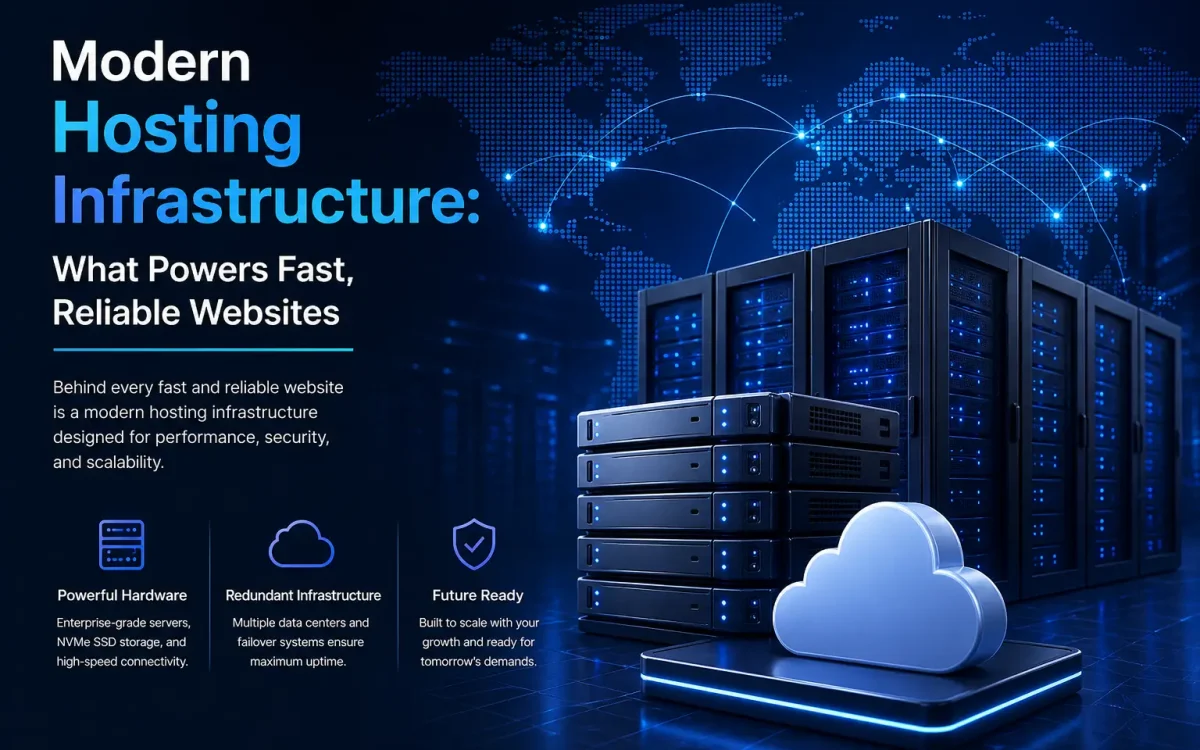
The website you visit is just the visible tip of a much larger system. Modern hosting infrastructure combines high-performance hardware, redundant networks, sophisticated cooling, and automated software to deliver milliseconds-fast experiences to millions of users. Understanding what goes on behind the scenes helps you choose the right hosting partner and recognize quality when you see it.
What Is Hosting infrastructure?
A serious hosting platform is built on five interconnected layers:
- Compute — physical servers running modern CPUs and high-density RAM.
- Storage — NVMe arrays for low latency and high IOPS.
- Networking — redundant Tier-1 transit, fiber backbones, and edge locations.
- Datacenter facility — power, cooling, security, and physical access control.
- Orchestration software — virtualization, monitoring, and automated failover.
Weakness in any single layer slows down or destabilizes the entire stack.
Compute: Where Performance Begins
Modern hosting hardware is dramatically more powerful than what was standard even a few years ago. AMD EPYC processors with 64-128 cores per socket and Intel Xeon Scalable chips with high clock speeds form the backbone of most production servers in 2026.
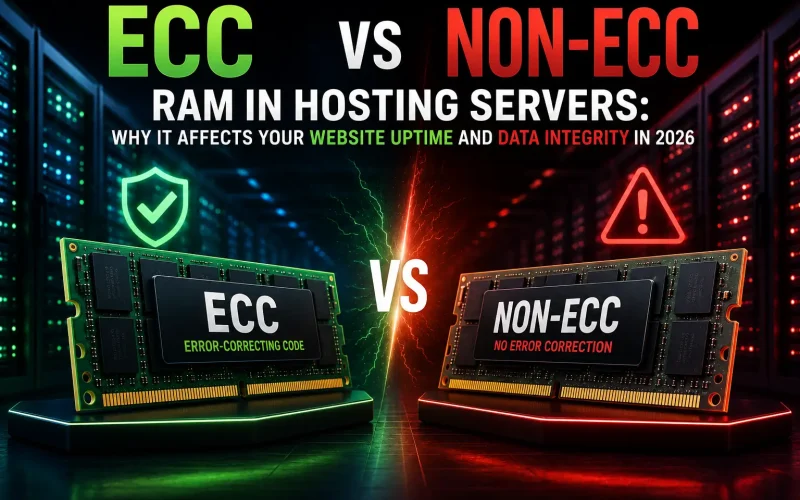
RAM has scaled in lockstep. ECC DDR5 memory at 256-512 GB per server is now common, allowing servers to keep large databases entirely in memory for sub-millisecond query response.
Storage: NVMe Changed Everything
The shift from SATA SSDs to NVMe drives is one of the most significant infrastructure changes of the past decade. NVMe drives deliver 1-2 million IOPS compared to SATA SSDs 100,000 IOPS — a 10-20x improvement.
For database-heavy workloads, this difference is the gap between a snappy site and one that times out under load. Quality hosts pair NVMe with hardware RAID for both performance and redundancy.
Networking: The Invisible Half
You can have the worlds fastest server, but if its connected to a slow or congested network, your site will feel sluggish. Modern hosting networks include:
- Multiple Tier-1 transit providers for redundancy and route optimization.
- 10 Gbps and 100 Gbps backbone links connecting datacenters.
- Anycast routing so visitors connect to the nearest edge.
- Built-in DDoS scrubbing to filter attack traffic upstream.
The Datacenter Itself
The physical building matters more than most people realize. Tier III and Tier IV datacenters provide:
- Redundant power feeds with UPS battery backup and diesel generators.
- Precision cooling that maintains stable server temperatures.
- 24/7 physical security with biometric access controls.
- Fire suppression systems that protect equipment.
- SOC 2 and ISO 27001 compliance for enterprise customers.
Software That Ties It All Together
Hardware alone is not enough. Modern hosting platforms layer on:
- Virtualization (KVM, Xen, VMware) to slice physical hardware into VMs.
- Orchestration tools like Proxmox, OpenStack, or proprietary control planes.
- Monitoring systems that track every server, disk, and network port in real time.
- Automated failover that moves workloads to healthy hardware when failures occur.
Why This Matters to You
When choosing a host, the marketing copy will rarely tell you which CPU generation, what storage type, or which datacenter tier is in play. Ask. Quality providers will answer transparently and back it up with documentation. Cheap providers will dodge the question.
Final Thoughts
Modern hosting infrastructure is the result of thousands of engineering decisions, made carefully over decades. The best hosts invest in every layer — compute, storage, networking, facilities, and software — and pass the resulting reliability and performance directly to their customers.
Further Reading
From our blog:
External resources: