- Why Enterprise Hardware Matters More Than Ever in 2026
- How Enterprise Hardware Differs from Consumer-Grade Servers
- How High Core Counts and Cache Boost Enterprise VPS Performance
- Enterprise NVMe vs Consumer SSD: The Real Storage Difference
- How Enterprise Hardware Accelerates WordPress and WooCommerce
- Scalability and Security Advantages of Enterprise Platforms
- Enterprise Hardware Delivers Lower Total Cost of Ownership
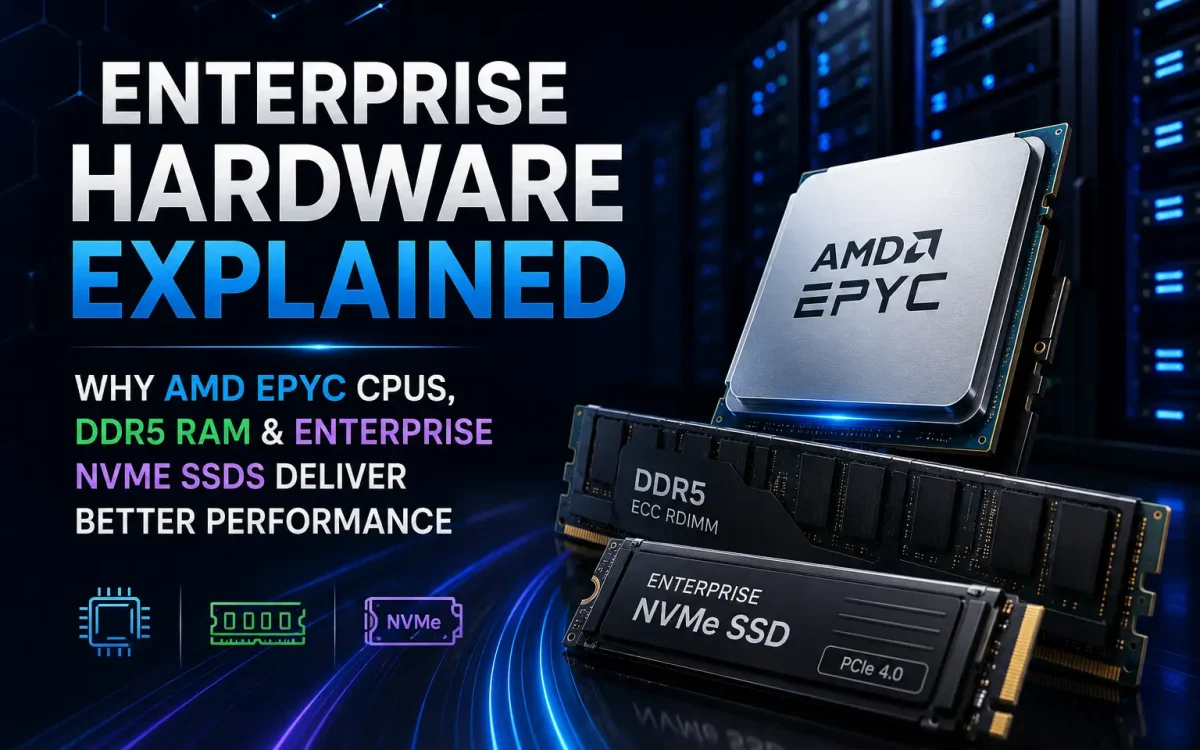
Enterprise hardware is the invisible reason a WordPress site loads in 400 ms on one host and 2 seconds on another — because the CPU model, RAM type, and NVMe controller decide performance long before any software optimisation happens. In 2026, enterprise hardware means AMD EPYC processors, DDR5 ECC memory, Samsung PM9A3 or Kioxia CM7 U.2 NVMe drives, and hardware RAID with battery-backed controllers. This guide explains what qualifies as enterprise hardware, how each component compares to consumer-grade parts, and why UK businesses on UK Speed premium network hosting notice the difference in Core Web Vitals from the first day.
Why Enterprise Hardware Matters More Than Ever in 2026
Websites and business applications in 2026 are simultaneously heavier and more visible than ever. Google’s Core Web Vitals penalise slow load times in ranking, WooCommerce customers abandon at the first checkout hang, and remote workforces depend on hosted business apps that must feel local. Enterprise hardware is the foundation that makes these expectations achievable — because software optimisation cannot overcome an underpowered CPU, a memory bus starved of bandwidth, or a storage subsystem with unpredictable latency. Choosing hosting with enterprise hardware puts your site on infrastructure engineered for continuous production, not marketing benchmarks.
How Enterprise Hardware Differs from Consumer-Grade Servers
Enterprise hardware is not just faster consumer hardware — it is engineered around a different objective. Consumer chips maximise peak performance for short bursts (gaming, benchmarks); enterprise hardware maximises sustained throughput and reliability across years of 24/7 load. Enterprise CPUs run at lower clocks but with vastly more cores and cache. Enterprise NVMe drives have power-loss protection and 10-30x more write endurance. Enterprise RAM uses ECC to silently correct memory errors that would crash consumer systems. Enterprise motherboards support 12+ memory channels, remote KVM, and IPMI management. This is why our transparent hosting specifications guide insists on exact model numbers before purchase.
Why AMD EPYC Is the New Enterprise Hardware Standard
AMD EPYC has redefined the enterprise CPU category since 2019, and the 2025 Turin generation (EPYC 9005 series) is the strongest case yet. The flagship EPYC 9755 delivers 128 cores and 256 threads with 512 MB of L3 cache on a single socket — numbers unmatched by any Intel Xeon at comparable power draw. Zen 5 architecture, 4 nm manufacturing, and SME (Secure Memory Encryption) make it the natural choice for virtualised hosting. Our AMD EPYC vs Intel Xeon comparison documents the workload-by-workload gap on real UK hosting.
How High Core Counts and Cache Boost Enterprise VPS Performance
Every VPS on a shared host draws its CPU slice from the physical processor. A 128-core AMD EPYC 9755 hosts far more VPS instances at consistent performance than a 32-core consumer CPU trying to serve the same workload — because oversubscription pressure per core drops with every additional physical thread. Large L3 cache (512 MB on EPYC 9755) reduces main-memory round trips, so database queries and PHP execution stay resident inside the CPU instead of stalling on RAM latency. For heavy WordPress or WooCommerce workloads on enterprise hardware, cache size often matters more than clock speed on paper.
Why DDR5 ECC RAM Belongs in Every Enterprise Server
DDR5 is not a spec sheet upgrade — it is a 50% memory bandwidth jump over DDR4 at the same channel count. Combined with ECC (error-correcting code), enterprise DDR5 detects and silently corrects single-bit errors before they crash processes or corrupt databases. Modern DDR5 includes both on-die ECC and link ECC, doubling the protection. On a hosting node running dozens of VPS with billions of memory transactions per hour, non-ECC RAM occasionally corrupts data in ways that only surface as unexplained crashes weeks later. Our ECC vs non-ECC RAM guide explains the mechanism in production detail.
Enterprise NVMe vs Consumer SSD: The Real Storage Difference
Consumer SATA SSDs peak at 40,000 IOPS on 4 KB random reads and slow dramatically under sustained mixed workloads because they lack DRAM cache. Consumer NVMe reaches 400,000 IOPS but the low-power TLC NAND wears out under database write loads. Enterprise NVMe drives — Samsung PM9A3, Kioxia CM7, Intel D7-P5520 — sustain 1,000,000+ IOPS with predictable low latency and endure 10-30x more write cycles thanks to over-provisioning, power-loss capacitors, and thicker error correction. Our UK VPS NVMe vs SSD benchmark shows exactly what this means for WordPress and WooCommerce response times.
Why High IOPS and Low Latency Define Enterprise Storage
Sequential throughput headlines make marketing copy but do not reflect production reality. A busy WordPress site makes small, random reads and writes constantly — page loads, session data, transient options, WooCommerce cart operations. Random IOPS at 4 KB block size is what matters, and enterprise NVMe drives sustain 3-5x the IOPS of consumer drives under sustained load. Enterprise hardware also delivers predictable latency: 99th-percentile response time under 200 microseconds, versus consumer drives that occasionally stall for 10+ milliseconds when garbage collection kicks in. Consistent low latency is why enterprise-hosted sites feel snappier under real traffic.
Why Enterprise Hardware Is Essential for Virtualization
Hosting providers deliver VPS by dividing physical servers into isolated slices. This only works when the underlying enterprise hardware has the CPU, memory bandwidth, and I/O queues to serve every slice without contention. KVM virtualization on EPYC processors gives every VPS a dedicated cache partition (thanks to CAT — Cache Allocation Technology), hard NUMA affinity, and independent NVMe queues. Consumer-grade hosts running OpenVZ containers share caches and swap slots, which is how “premium” hosting VPS on cheap hardware ends up 5x slower than the same specs on enterprise hardware.
How Enterprise Hardware Accelerates WordPress and WooCommerce
WordPress is CPU-bound on PHP execution and I/O-bound on database queries. Enterprise hardware attacks both bottlenecks: AMD EPYC single-thread performance runs PHP-FPM 30-40% faster than 2018-era Xeon at the same clock, and enterprise NVMe brings MySQL query latency below 5 ms consistently. On a WooCommerce store during a flash sale, this compounds: each additional millisecond of database latency is multiplied across thousands of concurrent sessions. Enterprise hardware turns hardware ceiling into a non-issue so you can focus on plugin optimisation and cache tuning.
Scalability and Security Advantages of Enterprise Platforms
Enterprise hardware scales gracefully because it was designed for datacenter density: hot-swap components, redundant PSUs, remote IPMI management, and platform-firmware features that enable live migration between hosts. Security-wise, EPYC’s SME (Secure Memory Encryption) transparently encrypts VPS memory at the hardware layer, preventing memory-scraping attacks even during a hypervisor breach. TPM 2.0 chips enable measured boot for tamper-evident startup. These are not luxuries — they are why enterprise hardware is the only platform serious UK compliance frameworks (GDPR, PCI-DSS, ISO 27001) accept without additional mitigations.
Enterprise Hardware Delivers Lower Total Cost of Ownership
Enterprise hardware costs more per unit but less per dollar of hosted revenue. A single enterprise node hosts 3-5x more VPS at guaranteed performance than consumer hardware, so per-customer CPU and RAM cost drop. Enterprise drives with 3 DWPD endurance last 5-7 years under production load, compared to 2-3 years for consumer drives at equivalent write volume. Fewer support tickets, fewer emergency migrations, and fewer downtime incidents all convert directly into lower operating cost. For UK hosting providers running dozens of nodes, enterprise hardware is the only economically rational baseline.
Why UK Speed Runs Enterprise Hardware in Every Tier
UK Speed builds every tier on enterprise hardware — from shared hosting to full dedicated Turin Cloud servers. The Turin generation uses AMD EPYC 9755 with 128 cores, 512 GB DDR5 ECC RAM at 4800 MHz, Samsung PM9A3 NVMe U.2 drives in RAID 10 with battery-backed cache, and premium multi-transit UK network peering. Every specification is published, benchmarkable, and contractually guaranteed. See the full UK Speed Turin Cloud Servers explanation for the complete enterprise hardware build sheet.
Who Benefits Most from Enterprise Hardware Hosting
Every hosted workload gains from enterprise hardware, but four groups gain the most. WooCommerce and Shopify-alternative stores at £10k+ monthly revenue where downtime costs immediately outweigh hosting savings. WordPress agencies managing 20+ client sites where consistent performance protects retention. SaaS and B2B applications where API latency defines competitive positioning. UK compliance-driven organisations — NHS Digital, legal, financial — where auditable hardware is non-negotiable. For an in-depth AMD architectural reference, see the official AMD EPYC 9005 series page.
Conclusion: Enterprise Hardware Powers 2026 UK Growth
Enterprise hardware is not a marketing tier — it is the engineered floor beneath every serious UK hosting decision in 2026. AMD EPYC compute, DDR5 ECC memory, enterprise NVMe storage, and hardware RAID together deliver the consistent low-latency performance that Core Web Vitals demand and business applications depend on. UK Speed publishes every enterprise hardware detail because great hosting starts with honest, professional components.