
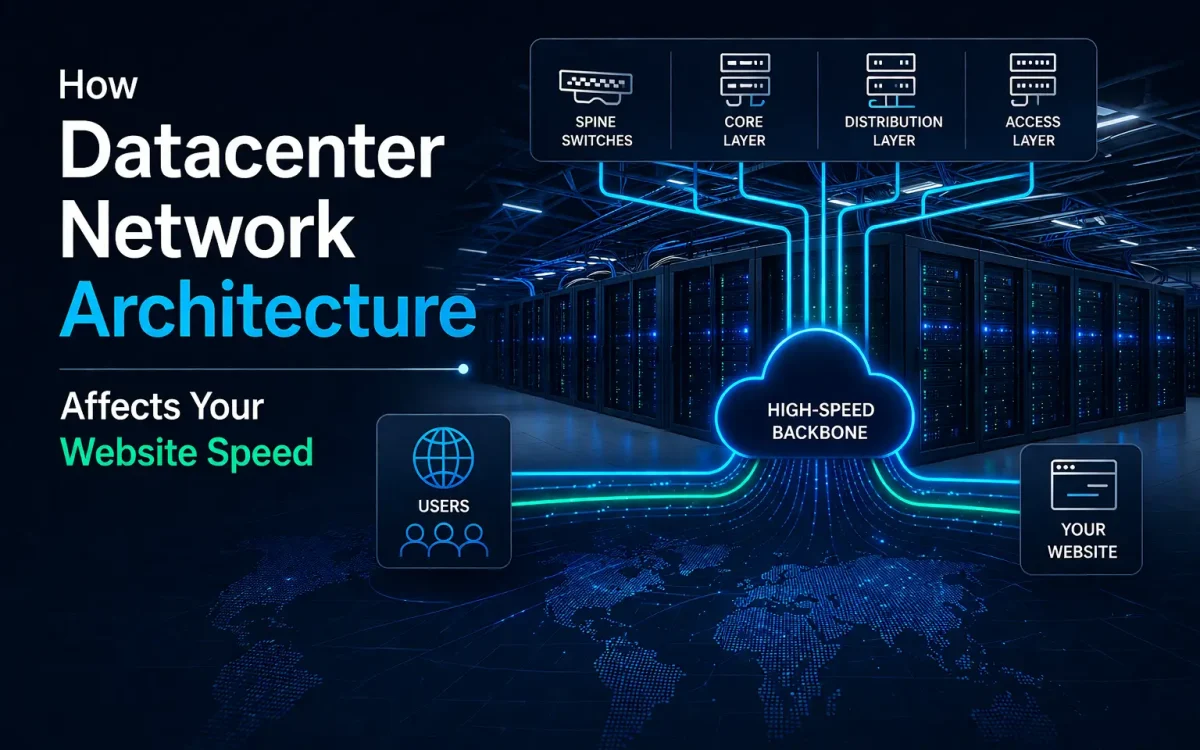
You can have the fastest server hardware in the world, but if its sitting behind a slow network, your visitors will still experience a sluggish site. Datacenter network architecture — the way servers connect to each other and to the wider internet — is one of the most under-appreciated factors in web hosting performance.
What Is Datacenter network?
Every page load involves dozens of round trips between the visitors browser and your server. Each round trip is bottlenecked by the slowest link in the chain. A 50 ms delay multiplied across 30 requests becomes 1.5 seconds of perceived slowness — even if your server processes each request in microseconds.
Quality datacenter networks reduce these round trips, route traffic intelligently, and absorb attacks before they reach your server.
Tier-1 vs Tier-2 vs Tier-3 Providers
Internet transit providers are categorized by how they exchange traffic:
- Tier-1 providers (NTT, Lumen, Telia, GTT) own backbone fiber globally and peer directly with each other. Traffic on Tier-1 networks reaches its destination with minimum hops.
- Tier-2 providers buy transit from Tier-1 networks and peer where it makes sense. Reasonable performance, more cost-effective.
- Tier-3 providers buy all their transit from upstream providers. Slower and less reliable.
Quality hosts connect to multiple Tier-1 providers for redundancy and route optimization.
Latency: The Hidden Performance Killer
Latency is the time a packet takes to travel from point A to point B. Even at the speed of light through fiber, distance matters:
- London to New York: ~70 ms one way.
- London to Singapore: ~170 ms one way.
- London to Sydney: ~270 ms one way.
For a UK audience, hosting in a London datacenter cuts round-trip latency to single-digit milliseconds — instantly noticeable in page load speed.
Bandwidth vs Throughput
Bandwidth is the size of the pipe; throughput is how much data actually flows through it. A “1 Gbps” connection might only deliver 200 Mbps of real-world throughput due to packet loss, congestion, or oversubscription.
Quality datacenters maintain low oversubscription ratios (often 1:1 for premium tiers) and monitor throughput continuously to catch congestion before it impacts customers.
Anycast and Global Routing
Anycast routing lets multiple servers in different locations share the same IP address. The internets routing protocols automatically direct each visitor to the nearest server. This is how CDNs deliver low-latency content globally.
For dynamic applications, Anycast at the network layer combined with intelligent application routing can dramatically reduce time-to-first-byte for international visitors.
DDoS Protection at the Network Edge
Modern attacks can exceed 1 Tbps. No individual server can absorb that much traffic. Quality datacenters scrub DDoS traffic at the network edge — often hundreds of gigabits before it ever reaches your server.
Look for hosts that include automatic DDoS protection rather than charging extra. Reactive protection (added during an attack) is always slower than always-on filtering.
Internal Datacenter Networking
Inside a datacenter, server-to-server communication matters as much as external connectivity. Modern facilities use:
- 10/40/100 Gbps top-of-rack switches.
- Spine-leaf architecture for predictable latency between any two servers.
- Private VLANs for secure database-to-app server communication.
- Dedicated storage networks separate from public traffic.
How to Evaluate a Hosts Network
When researching hosts, look for these signals:
- Public peering policy and looking-glass tools.
- Multiple named Tier-1 transit providers.
- Specified bandwidth (not just “unmetered”).
- Documented DDoS protection (e.g., “20 Gbps automatic”).
- Low oversubscription ratios on premium plans.
Final Thoughts
Network architecture is invisible until it matters — and when it matters, theres no fixing it from your end. Choose hosts that invest in real Tier-1 connectivity, low-latency routing, and built-in DDoS protection. Your visitors will feel the difference even if they cannot articulate why.
Further Reading
External resources:


