
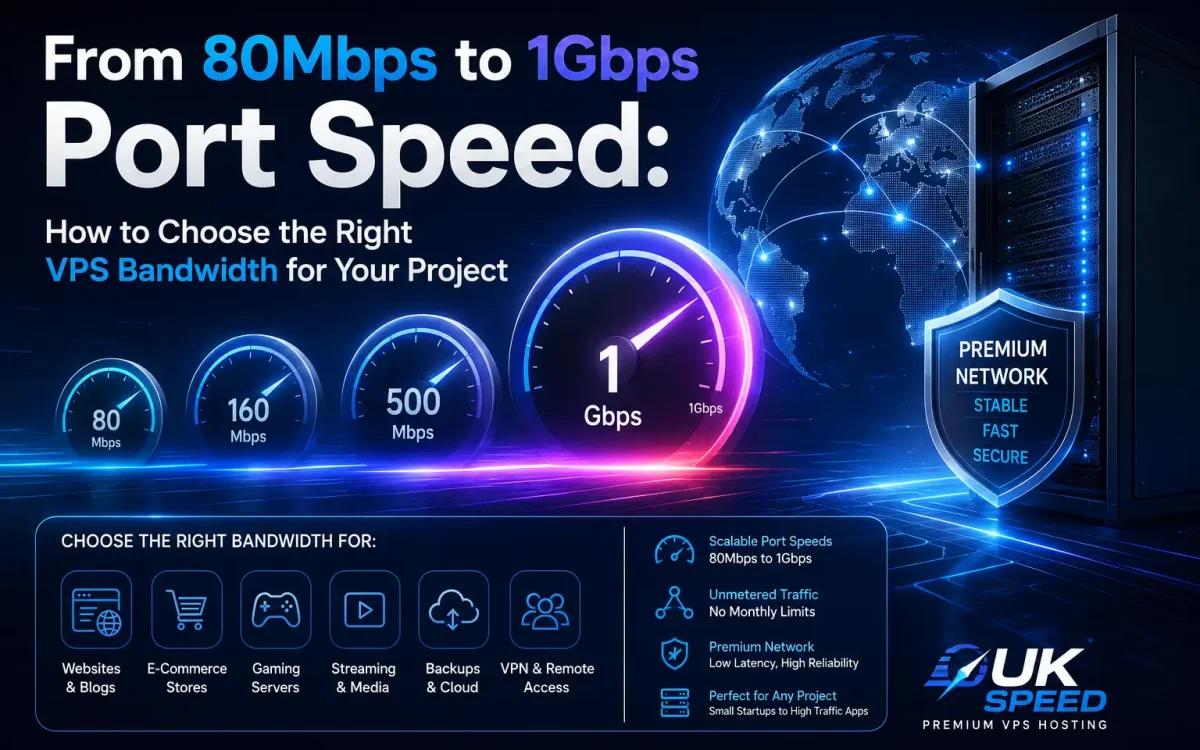
- Introduction: Why VPS Port Speed Matters More Than Ever in 2026
- What Is VPS Port Speed?
- Port Speed vs Monthly Bandwidth Limits
- Why Choosing the Right VPS Bandwidth Is Important
- 80Mbps VPS Port Speed: Efficient and Reliable Starting Point
- 160Mbps VPS Port Speed: More Room for Growing Projects
- 1Gbps VPS Port Speed: Maximum Performance for Serious Workloads
- How to Decide Which Port Speed You Need
Introduction: Why VPS Port Speed Matters More Than Ever in 2026
When choosing a VPS hosting plan, most users immediately compare CPU cores, RAM size, and storage capacity. While these resources are important, they are only part of the performance equation.
One of the most critical factors that directly affects real-world server performance is often ignored:
VPS Port Speed and Network Bandwidth.
A powerful server with a weak network connection can still create problems such as:
- Slow downloads
- High response times
- Limited simultaneous users
- Poor VPN performance
- Application delays
In 2026, modern projects require more data transfer, faster connectivity, and better network reliability.
Choosing the right VPS bandwidth capacity is essential for:
- Websites
- VPN services
- Business applications
- File servers
- Backup solutions
- Streaming platforms
- ISP systems
UK Speed provides flexible bandwidth options designed for different workloads, from efficient 80Mbps connections to powerful 1Gbps VPS solutions.
What Is VPS Port Speed?
VPS Port Speed represents the maximum network connection speed available between your virtual server and the internet.
It determines how quickly your VPS can send and receive data.
Common VPS port speeds include:
- 80Mbps
- 160Mbps
- 320Mbps
- 500Mbps
- 1Gbps
Higher port speeds allow your server to handle more traffic at the same time.
Port speed affects:
- Website loading
- File transfers
- VPN throughput
- Backup speed
- User experience
- Application performance
Bandwidth is not only about how much data you can transfer.
It is also about how fast your infrastructure can deliver that data.
Port Speed vs Monthly Bandwidth Limits
Many VPS providers advertise monthly traffic numbers such as:
- 5TB bandwidth
- 10TB bandwidth
- 20TB bandwidth
However, monthly traffic limits do not always explain real performance.
A server may have a large monthly allowance but still suffer from limited speed during heavy usage.
Port speed based bandwidth focuses on real network capacity.
This approach provides:
- Better performance visibility
- More predictable capacity
- Easier scalability
- Better support for demanding workloads
Why Choosing the Right VPS Bandwidth Is Important
Every project has different network requirements.
Choosing too little bandwidth can create:
- Slow performance
- Network congestion
- Poor customer experience
Choosing the correct bandwidth allows:
- Smooth operation
- Room for growth
- Better reliability
- Stable user experience
The goal is not always choosing the highest speed.
The goal is choosing the right capacity for your workload.
80Mbps VPS Port Speed: Efficient and Reliable Starting Point
An 80Mbps VPS connection is suitable for many standard projects.
Recommended for:
- Small business websites
- WordPress hosting
- Development servers
- Personal applications
- Testing environments
- Lightweight services
Advantages:
- Cost effective
- Stable performance
- Suitable for normal traffic
- Efficient resource usage
For many websites and applications, 80Mbps provides enough capacity when combined with a quality network.
160Mbps VPS Port Speed: More Room for Growing Projects
A 160Mbps VPS connection provides additional capacity for growing workloads.
Recommended for:
- Medium websites
- Multiple hosted projects
- Business applications
- Small VPN servers
- Remote access systems
Benefits include:
- More simultaneous connections
- Better file transfer performance
- Improved traffic handling
This level is a strong choice for users expecting consistent growth.
320Mbps VPS Port Speed: High Traffic Performance
A 320Mbps VPS connection is designed for heavier workloads.
Recommended for:
- High traffic websites
- Larger applications
- VPN services
- Customer platforms
- Content delivery systems
Projects at this level usually need:
- More bandwidth availability
- Faster response times
- Better user capacity
For professional environments, network performance becomes a major factor.
500Mbps VPS Port Speed: Advanced Business Infrastructure
A 500Mbps VPS connection is suitable for demanding online services.
Common use cases:
- Commercial VPN services
- Large applications
- File distribution
- Backup servers
- Enterprise systems
Benefits:
- High traffic handling
- Faster transfers
- Better scalability
- Improved customer experience
Businesses with continuous traffic requirements benefit from higher port speeds.
1Gbps VPS Port Speed: Maximum Performance for Serious Workloads
A 1Gbps VPS connection is designed for projects requiring maximum network performance.
Ideal for:
- VPN providers
- ISP solutions
- MikroTik CHR environments
- Large platforms
- Enterprise applications
- Heavy data transfer systems
A 1Gbps VPS provides:
- High throughput
- Excellent scalability
- Support for many simultaneous users
- Professional network capacity
For businesses where network performance directly affects customers, 1Gbps provides a stronger foundation.
Choosing VPS Bandwidth for WireGuard VPN
VPN servers are among the most bandwidth-demanding workloads.
Every connected user sends traffic through the VPS.
WireGuard VPN performance depends heavily on:
- Port speed
- Network quality
- Latency
- Traffic capacity
Small VPN deployments may work with lower speeds.
Commercial VPN services usually require higher bandwidth options.
More users mean more network demand.
Choosing VPS Bandwidth for Websites and Applications
Websites have different requirements depending on traffic levels.
A small website may only need moderate bandwidth.
A growing online platform requires more capacity.
Factors that increase bandwidth usage:
- More visitors
- Large images
- Downloads
- Videos
- API requests
- User uploads
Planning bandwidth correctly helps avoid future limitations.
Choosing VPS Bandwidth for Backup and Storage Servers
Backup workloads require strong upload and download performance.
Examples:
- Remote backups
- Cloud storage
- Data synchronization
- File servers
Higher port speeds reduce transfer times and improve efficiency.
For frequent large backups, network capacity is extremely important.
Why Network Quality Is as Important as Speed
A high port speed alone does not guarantee excellent performance.
Network quality also depends on:
- Routing
- Stability
- Latency
- Packet delivery
- Infrastructure quality
A Premium Network VPS provides a better experience because the entire connection path is optimized.
Speed numbers matter, but reliability matters even more.
UK Speed Premium Network Bandwidth Options
UK Speed focuses on providing flexible VPS network solutions for different types of customers.
Whether your project requires a basic connection or high traffic infrastructure, choosing the correct port speed allows better performance planning.
UK Speed VPS solutions are designed for:
- Developers
- Businesses
- Agencies
- VPN providers
- ISPs
- Enterprise users
With Premium Network infrastructure, customers can build services that require reliability and scalability.
How to Decide Which Port Speed You Need
Choose based on your workload:
Small projects:
80Mbps – 160Mbps
Best for websites, testing, and lightweight applications.
Growing services:
160Mbps – 320Mbps
Best for business applications and increasing traffic.
Professional workloads:
320Mbps – 500Mbps
Best for VPN services, large websites, and platforms.
Enterprise usage:
500Mbps – 1Gbps+
Best for ISP solutions, VPN providers, and heavy traffic systems.
Future Growth: Always Plan Ahead
Network requirements usually increase over time.
Projects grow through:
- More users
- More services
- More data
- More applications
Choosing scalable VPS bandwidth helps avoid future migration problems.
A flexible network infrastructure allows your project to expand smoothly.
Conclusion: The Right VPS Port Speed Creates Better Performance
Choosing a VPS is not only about CPU, RAM, or storage.
Network performance is one of the most important parts of modern infrastructure.
From 80Mbps to 1Gbps VPS Port Speed, every level serves different requirements.
The best choice depends on:
- Project size
- Number of users
- Traffic volume
- Application type
- Future growth
UK Speed Premium Network VPS solutions provide flexible bandwidth options designed for modern workloads.
Whether you run a website, VPN service, ISP platform, or enterprise application, choosing the right VPS bandwidth creates a faster, more reliable experience for your customers.
Further Reading
For an authoritative reference on this topic, see Google web.dev — Why Speed Matters.
Looking for fast, secure hosting?
Visit UK Speed for cloud servers, VPS NVMe, and dedicated hosting tailored for performance.