
- Why Transparent Hosting Specifications Matter Before You Buy in 2026
- How Vague Hosting Advertisements Mislead UK Buyers
- Enterprise NVMe vs Consumer SSD: The Real Storage Difference
- Network Port Speed in Transparent Hosting Spec Sheets
- How Transparent Hosting Builds Long-Term Customer Trust
- Conclusion: Choose Transparent Hosting for 2026
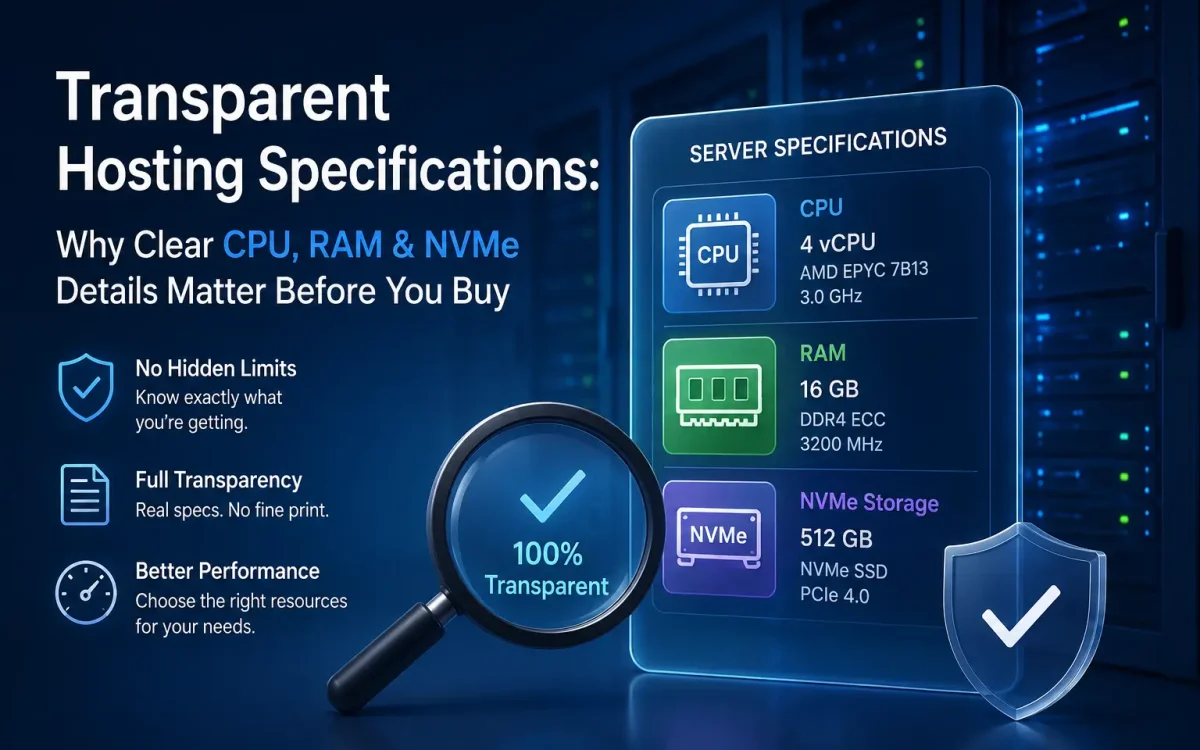
Transparent hosting is the buying discipline every UK business needs in 2026, because vague marketing terms like “Premium SSD” and “Enterprise Cloud” hide the exact CPU model, RAM type, NVMe generation, and network uplink you are actually paying for. Choosing a hosting provider without a complete hardware specification sheet is a bet against your own website’s speed, reliability, and Core Web Vitals. This guide breaks down every hardware component a genuinely transparent hosting provider publishes — CPU model, RAM frequency, NVMe controller, RAID pattern, port speed, and virtualization layer — and shows exactly what to compare before you buy on UK premium network hosting.
Why Transparent Hosting Specifications Matter Before You Buy in 2026
Every millisecond of Core Web Vitals, every uncached WooCommerce checkout, and every database query on a WordPress site depends on the exact hardware running underneath. Transparent hosting tells you that hardware before you sign — CPU model, RAM frequency, NVMe controller, port speed, virtualization layer. Vague marketing hides it, and you discover the truth only after your site performs 3-5x slower than the sales page promised. In 2026, with hosting margins compressed and hardware costs varying by 10x between consumer and enterprise tiers, the specification sheet is the single most valuable document a provider can publish.
How Vague Hosting Advertisements Mislead UK Buyers
“Premium SSD” can mean a five-year-old consumer SATA drive or a brand-new NVMe U.2 enterprise disk — the difference is a 20x IOPS gap. “High-Speed Network” can mean a 100 Mbps shared uplink or a 1 Gbps guaranteed port. “Powerful CPU” can mean a 2017 Xeon E5 or a 2025 AMD EPYC. Without a specification sheet, these terms are marketing wallpaper. The provider is free to swap in the cheapest hardware and still claim compliance with its own vague language. Transparent hosting refuses this trick by publishing the exact model number that goes into every server.
Why the CPU Model Is Non-Negotiable in Transparent Hosting
CPU generation drives single-thread performance, which drives PHP execution speed, which drives WordPress TTFB. A 2018 Xeon Gold delivers roughly 40% of the single-thread throughput of a 2025 AMD EPYC 9755, at the same core count. Transparent hosting publishes the exact model — AMD EPYC 9755 128-core or Intel Xeon Gold 6444Y — so you can look up benchmarks and match cores to your workload. Our comparison of AMD EPYC vs Intel Xeon dedicated servers shows exactly why the model matters more than the marketing tier name.
Why Transparent Hosting Publishes RAM Type and Frequency
Two identical VPS with “16 GB RAM” can perform 30% differently based on the RAM type. DDR4 at 2666 MHz is common on older hardware; DDR5 at 4800 MHz is standard on 2025+ platforms. Even more critical is ECC — error-correcting memory that detects and repairs bit flips silently. Non-ECC RAM occasionally corrupts data in ways that only surface as unexplained crashes or database inconsistencies weeks later. Transparent hosting states the type, frequency, and ECC status explicitly. Our ECC vs non-ECC RAM guide explains why this single line matters for production data integrity.
Enterprise NVMe vs Consumer SSD: The Real Storage Difference
Consumer SATA SSDs deliver around 40,000 IOPS on random 4 KB reads. Consumer NVMe drives reach 400,000 IOPS. Enterprise NVMe U.2 drives — Samsung PM9A3, Kioxia CM7, Intel D7-P5520 — sustain 1,000,000+ IOPS with predictable latency under mixed workloads and endure 10-30x more write cycles. Transparent hosting names the exact drive so you can verify. Real-world differences on WordPress and WooCommerce workloads are documented in our UK VPS NVMe vs SSD benchmark.
Why Transparent Hosting Discloses the RAID Level
Even the best NVMe drive fails. What matters is what happens next. RAID 1 (mirroring) or RAID 10 (mirror plus stripe) tolerates drive failure without any data loss or downtime — your VPS keeps running while the failed drive is hot-swapped. RAID 0 offers no protection at all; a single failed drive erases the entire host. Transparent hosting states the RAID level explicitly, so you know whether your data survives the inevitable drive death. A hosting provider that omits this line either uses no RAID or does not want you asking.
Network Port Speed in Transparent Hosting Spec Sheets
“High-Speed Network” is meaningless without two numbers: the guaranteed port speed on your VPS and the datacenter uplink capacity. A 1 Gbps port on a 100 Gbps uplink to a Tier 1 UK IX is world-class; a 100 Mbps burstable port on a shared 10 Gbps uplink is congested by design. Transparent hosting publishes both. Our UK Speed vs global VPS providers comparison shows why premium network peering and full port speed transform Core Web Vitals on real UK traffic.
Why Transparent Hosting Names the Virtualization Layer
KVM virtualization gives every VPS a dedicated slice of CPU, RAM, and disk — resources are hard-partitioned and cannot be starved by noisy neighbours. OpenVZ and container-based virtualization share resources dynamically, which sounds efficient until another customer runs a crypto miner and your PHP-FPM latency triples. Transparent hosting states the virtualization layer explicitly — KVM (QEMU-KVM 8.x) — so you know whether your specs are guaranteed or shared. Providers that hide the virtualization type usually run oversold OpenVZ hosts to squeeze margin.
How Transparent Hosting Builds Long-Term Customer Trust
Trust in hosting is earned incident by incident. When a hosting provider publishes complete hardware transparency up-front, every future performance conversation starts from shared reality. A customer running a slow WordPress query knows exactly which CPU generation, RAM frequency, and NVMe controller their VPS uses, so debugging is grounded in facts. Support tickets become collaborative. Migrations to larger plans become predictable. Providers that hide specifications lose this trust the moment a real incident exposes what was actually under the hood.
Why UK Speed Publishes Full Hardware Specifications
UK Speed publishes the complete specification for every hosting tier: exact CPU model (AMD EPYC 9755 on Turin Cloud, Intel Xeon Gold on legacy tiers), DDR5 4800 MHz ECC RAM, Samsung PM9A3 enterprise NVMe U.2 drives with RAID 10 and hot spare, KVM virtualization, and 1 Gbps guaranteed port speed on a premium multi-transit UK uplink. Every number is auditable, benchmarkable, and contractually enforceable. See the UK Speed Turin Cloud Servers explanation for the complete Turin tier build sheet.
Better Hardware Delivers Better Business Results
Transparent hosting is not just an ethical position — it converts into measurable business outcomes. A WordPress site on AMD EPYC 9755 + DDR5 ECC + Samsung PM9A3 NVMe hits sub-100 ms TTFB consistently, passes Core Web Vitals on every audit, and handles traffic spikes without CPU throttling. A WooCommerce store on the same stack processes checkout at a fraction of the average provider’s latency. Transparent hosting turns marketing promises into engineering guarantees, and engineering guarantees turn into higher conversion rates and lower cart abandonment.
Questions to Ask Any UK Hosting Provider Before Buying
Seven questions separate transparent hosting from marketing theatre. (1) What is the exact CPU model and generation? (2) Is the RAM DDR4 or DDR5, ECC or non-ECC, and at what frequency? (3) What is the NVMe drive model and controller? (4) What RAID level protects the array? (5) What is the guaranteed port speed and datacenter uplink capacity? (6) What virtualization layer runs the VPS? (7) Is the bandwidth allowance metered or unmetered by port speed? If a provider hesitates on any of these, walk. For deeper context on how hosting infrastructure decisions shape the industry, see the Cloudflare hosting fundamentals guide.
Conclusion: Choose Transparent Hosting for 2026
Transparent hosting is the fastest filter for choosing a 2026 UK hosting provider. If the specification sheet lists exact CPU, RAM, NVMe, RAID, network, and virtualization details, the provider has skin in the game. If it hides behind vague marketing terms, the hardware is probably the reason. UK Speed publishes every spec because we believe great hosting starts with honest hardware.