
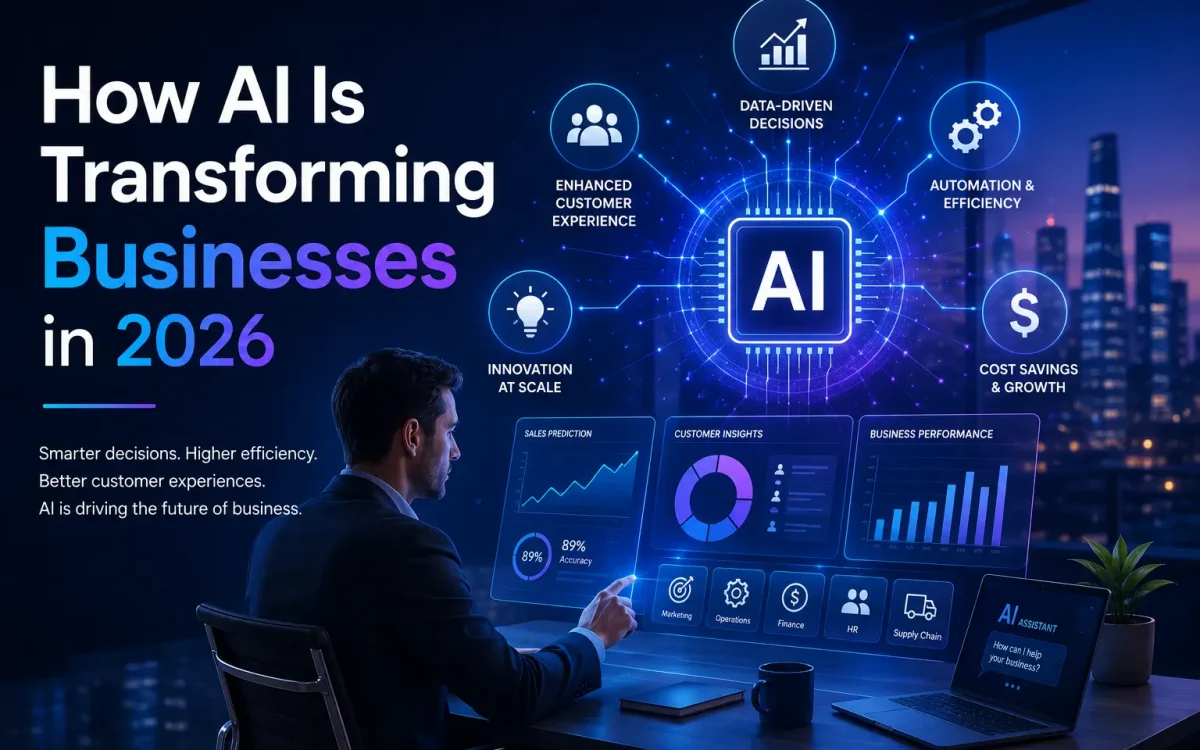
Artificial Intelligence is no longer a futuristic concept reserved for large technology corporations. In 2026, AI has become one of the most powerful technologies driving business transformation across nearly every industry. From automation and customer support to data analysis, cybersecurity, content generation, and predictive decision-making, AI is changing how companies operate, compete, and grow.
Businesses worldwide are investing heavily in AI technologies to improve efficiency, reduce operational costs, increase productivity, and create better customer experiences. Startups, eCommerce stores, healthcare providers, financial companies, logistics platforms, and hosting providers are all integrating AI into their daily operations.
The rapid rise of AI infrastructure, GPU servers, cloud computing, and large language models has made artificial intelligence more accessible than ever before. Companies that adopt AI early are gaining major competitive advantages, while businesses that ignore AI risk falling behind in increasingly digital markets.
In this guide, we explore how AI is transforming businesses in 2026, the most important real-world AI applications, emerging trends, infrastructure requirements, and what the future of AI-powered business looks like.
What Is AI in Modern Business?
Artificial Intelligence refers to systems capable of performing tasks that normally require human intelligence.
This includes:
- Understanding language
- Recognizing images
- Analyzing data
- Predicting outcomes
- Generating content
- Automating workflows
- Detecting threats
- Making recommendations
Modern AI technologies use:
- Machine learning
- Deep learning
- Neural networks
- Natural language processing
- Computer vision
- Predictive analytics
- Large language models (LLMs)
Businesses now use AI to automate repetitive tasks and improve decision-making at scale.
Why AI Adoption Is Growing Rapidly in 2026
Several factors are accelerating AI adoption worldwide:
Faster Computing Infrastructure
Modern AI systems rely heavily on:
- GPU servers
- NVMe storage
- High-core CPUs
- Cloud computing
- AI-optimized datacenters
These technologies allow businesses to process massive amounts of data quickly and efficiently.
AI Tools Are More Accessible
AI platforms are now available to businesses of all sizes.
Small businesses can access:
- AI chatbots
- AI writing tools
- AI automation systems
- AI analytics
- AI customer support platforms
without requiring large internal development teams.
Businesses Need Automation
Companies increasingly use AI to reduce manual workloads and improve operational efficiency.
Automation helps businesses:
- Save time
- Reduce staffing costs
- Improve response times
- Increase productivity
- Scale faster
Real-World AI Applications in 2026
AI is now deeply integrated into modern business operations.
AI Customer Support and Chatbots
One of the most visible AI applications is intelligent customer support.
AI-powered chat systems can:
- Answer customer questions
- Provide instant support
- Handle tickets automatically
- Route technical issues
- Translate conversations
- Operate 24/7
Modern AI chatbots are significantly more advanced than older scripted systems. They now understand context, customer intent, and natural language.
Businesses using AI support systems often improve:
- Customer satisfaction
- Response times
- Support scalability
- Operational efficiency
AI Content Creation
AI-generated content has become a major part of modern marketing strategies.
Businesses use AI for:
- Blog writing
- SEO optimization
- Product descriptions
- Social media posts
- Email campaigns
- Ad copy
- Video scripting
AI tools help companies create content faster while maintaining consistency across platforms.
However, businesses still need human editing and strategic oversight to ensure quality and originality.
AI in eCommerce
The eCommerce industry has adopted AI rapidly.
AI improves online stores through:
- Personalized recommendations
- Smart search systems
- Dynamic pricing
- Fraud detection
- Inventory forecasting
- Customer behavior analysis
- Automated marketing
Modern eCommerce platforms increasingly rely on AI to improve conversion rates and customer engagement.
AI Cybersecurity
Cybersecurity threats continue growing in sophistication, making AI-based security systems increasingly important.
AI helps businesses:
- Detect malware
- Identify suspicious activity
- Monitor network traffic
- Prevent fraud
- Analyze attack patterns
- Respond to threats faster
Hosting providers, financial companies, and enterprise businesses increasingly use AI-driven security monitoring systems.
AI in Healthcare
Healthcare organizations now use AI for:
- Medical imaging analysis
- Patient monitoring
- Predictive diagnostics
- Drug research
- Workflow automation
- Healthcare analytics
AI assists medical professionals in improving efficiency and identifying potential health issues more quickly.
AI in Finance
Financial institutions use AI for:
- Fraud detection
- Risk analysis
- Trading systems
- Credit scoring
- Customer service automation
- Financial forecasting
AI-driven analytics help financial companies process large amounts of transactional data rapidly.
AI in Software Development
AI coding assistants are transforming software engineering.
Developers use AI for:
- Code generation
- Debugging
- Documentation
- Automation
- API development
- Infrastructure management
AI tools significantly reduce development time for many projects.
AI Infrastructure and Hosting
Modern AI systems require powerful hosting infrastructure.
AI workloads demand:
- GPU acceleration
- High RAM capacity
- Fast NVMe storage
- Scalable VPS systems
- Low-latency networking
This has created massive demand for GPU hosting and AI-optimized servers.
Hosting providers like UKSpeed increasingly support modern high-performance infrastructure suitable for AI applications, scalable APIs, and demanding workloads.
GPU Servers and AI Computing
GPUs are now essential for many AI applications.
AI models such as:
- Stable Diffusion
- Large Language Models
- AI image generation systems
- Deep learning applications
perform significantly better using GPU acceleration.
Popular AI GPUs include:
- NVIDIA L4
- NVIDIA A100
- NVIDIA H100
- RTX enterprise GPUs
GPU hosting is becoming one of the fastest-growing segments of the hosting industry.
AI and Cloud Computing
Cloud infrastructure allows businesses to scale AI workloads rapidly.
Cloud AI environments help companies:
- Deploy models globally
- Scale applications quickly
- Reduce infrastructure management
- Improve reliability
- Handle large datasets
Many startups combine VPS hosting, dedicated servers, and cloud infrastructure for hybrid AI environments.
Future AI Trends in 2026 and Beyond
AI technology continues evolving rapidly.
Several trends are shaping the future of business AI.
AI Personal Assistants
Businesses increasingly use AI assistants for:
- Scheduling
- Research
- Customer support
- Workflow management
- Internal communication
AI assistants are becoming deeply integrated into daily operations.
AI Video Generation
AI-generated video content is growing rapidly.
Businesses use AI video systems for:
- Marketing
- Training
- Social media
- Product presentations
- Automated content creation
AI video tools are expected to become significantly more advanced in the coming years.
AI Agents and Automation
AI agents capable of performing multi-step tasks are becoming increasingly powerful.
These systems can:
- Browse information
- Execute workflows
- Manage customer requests
- Analyze data
- Automate operations
Businesses are expected to rely more heavily on AI agents for operational efficiency.
Self-Hosted AI Infrastructure
Some businesses prefer self-hosted AI systems instead of relying entirely on cloud AI providers.
Self-hosted AI environments offer:
- Greater privacy
- Better control
- Reduced long-term costs
- Infrastructure customization
This trend is increasing demand for AI VPS hosting and dedicated GPU servers.
AI and SEO
AI is changing SEO strategies dramatically.
Businesses now use AI for:
- Keyword research
- Content optimization
- Competitor analysis
- Technical SEO
- Content generation
However, search engines increasingly prioritize high-quality, helpful, and original content rather than purely AI-generated spam.
Successful SEO strategies combine AI efficiency with human expertise.
Challenges Businesses Face with AI
Despite its advantages, AI adoption also presents challenges.
Infrastructure Costs
AI systems often require expensive infrastructure such as:
- GPU servers
- Large storage systems
- High RAM environments
Data Privacy Concerns
Businesses handling sensitive data must ensure:
- Secure storage
- Encrypted communications
- Compliance with privacy regulations
AI Accuracy
AI systems can occasionally generate incorrect or misleading information.
Human oversight remains essential.
Skills and Integration
Some businesses struggle with:
- AI implementation
- Infrastructure management
- Staff training
- Workflow integration
Why Businesses Must Prepare for AI
AI is no longer optional for many industries.
Businesses that adopt AI effectively can:
- Reduce costs
- Improve productivity
- Scale faster
- Improve customer experiences
- Gain competitive advantages
Companies that ignore AI risk losing efficiency and market relevance over time.
The Role of Hosting Providers in AI Growth
As AI adoption grows, hosting providers play a critical role in supporting modern infrastructure requirements.
AI hosting environments require:
- Enterprise networking
- Fast NVMe storage
- GPU compatibility
- Scalable VPS systems
- High uptime reliability
UKSpeed provides scalable hosting infrastructure suitable for businesses building AI-powered platforms, SaaS applications, APIs, and modern digital services.
Final Thoughts
Artificial Intelligence is transforming businesses faster than almost any previous technology revolution.
From automation and customer support to cybersecurity, analytics, eCommerce, and AI-powered SaaS platforms, businesses across every industry are integrating AI into their operations.
Modern AI systems require powerful infrastructure, scalable hosting, fast networking, and high-performance computing environments capable of supporting demanding workloads.
As AI continues evolving in 2026 and beyond, businesses that embrace AI technologies strategically will gain major advantages in productivity, scalability, and innovation.
Companies investing early in AI infrastructure, automation, and scalable hosting environments position themselves for long-term success in the rapidly growing digital economy.
Further Reading
For an authoritative reference on this topic, see Cloudflare Learning — What Is VPS Hosting.