- Why UK VAT Changed for WooCommerce After Brexit
- Hosting in the UK for VAT Compliance
- How VAT Changed for British WooCommerce Stores
- How the £85,000 VAT Threshold Affects You
- How EU OSS and IOSS Work for UK Sellers
- Northern Ireland Protocol for WooCommerce Stores
- Configure WooCommerce Tax Settings for UK VAT
- Best Plugins for WooCommerce VAT in 2026
- How Hosting Affects WooCommerce VAT Reliability
- Conclusion
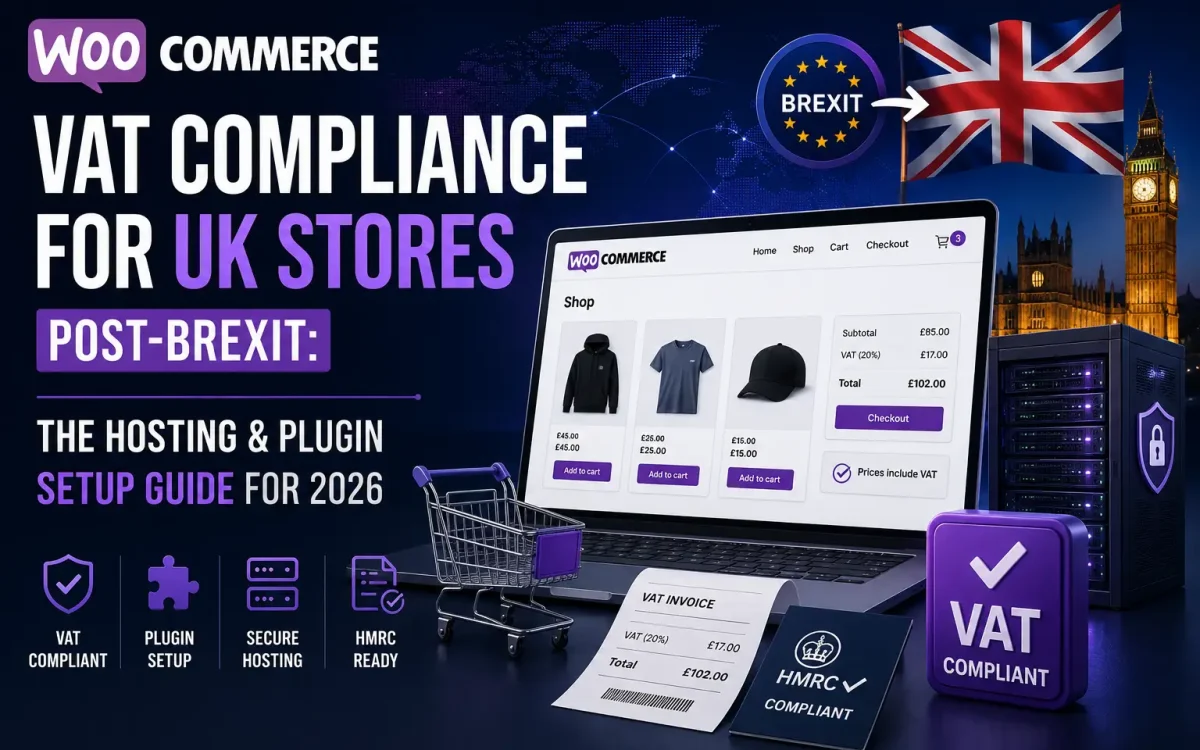
Running a WooCommerce store from the UK in 2026 means navigating a tax landscape that’s fundamentally different from the pre-Brexit world. WooCommerce UK VAT rules now sit at the intersection of HMRC’s domestic regime, the Northern Ireland Protocol, EU One-Stop Shop (OSS) reporting, and Import One-Stop Shop (IOSS) for B2C sales into the EU. Getting any of these wrong can trigger penalties, blocked shipments, or VAT-registered customers refusing to buy from you.
This guide walks UK store owners through the full setup: how Brexit changed VAT for WooCommerce, the £85,000 registration threshold, EU OSS and IOSS, the Northern Ireland Protocol, the right hosting setup for reliable tax calculations, and the best plugins to automate compliance in 2026.
Why UK VAT Changed for WooCommerce After Brexit
Before 31 December 2020, a UK WooCommerce store was inside the EU VAT system: a single VAT registration covered cross-border B2C sales up to country-specific distance-selling thresholds, and B2B sales used reverse-charge mechanics seamlessly. Brexit ended that simplicity overnight.
From 1 January 2021, the UK left the EU VAT area. Three big things changed for British WooCommerce stores:
- UK VAT became a fully domestic regime — sales to Great Britain (England, Scotland, Wales) charge UK VAT at 20% standard rate.
- EU sales are now exports/imports — handled via EU OSS / IOSS, or with VAT collected by the import country.
- Northern Ireland remains effectively dual-system — UK VAT for GB-to-NI movements, but EU VAT rules for NI-to-EU and EU-to-NI goods movements.
Hosting in the UK for VAT Compliance
HMRC’s Making Tax Digital (MTD) requirements mean your accounting records and tax submissions must be digitally connected to HMRC’s systems. For WooCommerce stores, that practical reality favours UK-hosted infrastructure for three reasons: lower latency between your store, your accounting system, and HMRC’s APIs; UK data residency for customer transaction records; and faster page loads for the British shoppers who are your VAT-paying customer base.
For deeper guidance on choosing the right infrastructure, see our breakdown of UK e-commerce hosting and how NVMe storage affects WooCommerce performance — both matter directly when tax calculation plugins run on every order.
How VAT Changed for British WooCommerce Stores
The post-Brexit rules apply differently depending on where your customer is and what they’re buying. The decision tree below summarises the four practical paths for a British WooCommerce store.
How the £85,000 VAT Threshold Affects You
HMRC’s UK VAT registration threshold is £90,000 of UK taxable turnover in any rolling 12-month period (raised from £85,000 in April 2024 — many guides still cite the old figure). Once you cross this, registration is mandatory within 30 days.
- Below £90K: registration is optional. You don’t charge VAT, can’t reclaim input VAT.
- Above £90K: registration mandatory. You charge 20% UK VAT and file via MTD-compliant software.
- Voluntary registration can make sense if most sales are B2B (your customers reclaim) or you have significant input VAT to recover.
- Distance selling to EU doesn’t count toward the UK threshold — those sales follow EU OSS / IOSS rules separately.
WooCommerce won’t track this for you automatically. You’ll need a reporting plugin or accounting integration (Xero, QuickBooks, FreeAgent) that watches your rolling 12-month UK turnover and flags when you’re approaching threshold.
How EU OSS and IOSS Work for UK Sellers
Selling to consumers in the EU after Brexit means dealing with one (or both) of these EU schemes:
- One-Stop Shop (OSS) — used by UK sellers who hold stock inside the EU (e.g. a fulfilment warehouse in the Netherlands). Register for OSS in one EU member state, file a single quarterly return covering B2C sales across all 27 members at each country’s local VAT rate.
- Import One-Stop Shop (IOSS) — used when goods ship from the UK to EU consumers and the order value is ≤ €150. Charge EU VAT at the customer’s country rate at checkout, file monthly. Below €150 and using IOSS, the customer pays no import VAT or handling fees on delivery — much better experience.
- Without OSS/IOSS — every EU consumer pays import VAT to the courier on delivery, often plus a £8-15 handling fee. Customers hate this and your conversion drops sharply.
For UK stores doing meaningful B2C volume into the EU, IOSS registration (via an EU intermediary) is essentially mandatory in 2026.
Northern Ireland Protocol for WooCommerce Stores
The Windsor Framework (which replaced the original Northern Ireland Protocol in 2023) keeps NI in a unique dual position for VAT:
- NI-to-GB and GB-to-NI goods: now flow under the “internal market system” — UK VAT applies, no customs declarations needed for goods staying in the UK customs territory.
- NI-to-EU and EU-to-NI goods: treated as EU intra-community supplies. NI businesses use the EU VIES system, EU sellers OSS.
- Services: NI is treated as UK for VAT on services — same as Great Britain.
- WooCommerce setup: configure tax classes that handle NI postcodes (BT prefix) as UK VAT for services but enable EU rules where the product is goods crossing to/from Ireland.
For most UK stores selling to NI customers, the simple answer is: charge UK VAT at 20% and let HMRC handle the rest.
Configure WooCommerce Tax Settings for UK VAT
The native WooCommerce tax settings handle UK VAT well if you configure them carefully. Walk through these settings in WooCommerce → Settings → Tax:
After the tax options are set, populate the Standard rates table with at least these rows: GB postcode pattern (20% standard), NI postcode pattern (BT*, 20%), and EU country codes with their local rates if you’re handling OSS in-store rather than via a plugin.
Best Plugins for WooCommerce VAT in 2026
- Aelia EU/UK VAT Assistant — the most complete option for stores selling across UK + EU. Handles OSS, IOSS, VIES validation for B2B, and proper invoice generation. Annual licence.
- WooCommerce Tax (Jetpack) — official, free, calculates UK and most international taxes automatically. Best for small UK-focused stores under the threshold.
- EU/UK VAT Compliance Assistant by WPFactory — good free tier, paid version adds OSS reporting.
- Quaderno — full tax-as-a-service SaaS with WooCommerce integration. Best when you also need automatic invoices, MTD submissions, and multi-jurisdiction reporting.
- WooCommerce VAT Number — small focused plugin that adds a VAT number field at checkout and validates it via the EU VIES service for B2B reverse-charge.
For most UK B2C stores, the Jetpack-bundled WooCommerce Tax is enough until volume grows. Once you’re over £90K turnover or selling B2B to EU customers, switch to Aelia or Quaderno.
How Hosting Affects WooCommerce VAT Reliability
Tax plugins query external services (VIES for B2B validation, OSS rate lookups, currency APIs) on every checkout that involves an EU customer. On underpowered shared hosting, these external calls can time out — leaving the customer with a checkout error or, worse, a successful order at the wrong VAT rate that you then have to refund.
- UK-based hosting — lower latency to HMRC APIs and to British shoppers. London-area data centres deliver sub-30 ms latency to most UK households.
- NVMe storage — tax lookups read product tax classes from the database on every cart update. NVMe vs SATA SSD matters for high-traffic stores.
- Sufficient PHP memory — VAT plugins are memory-heavy. Allocate at least 512 MB PHP memory_limit.
- Object cache (Redis) — cache the OSS rate table, VIES validation results, and currency conversions to avoid hitting external APIs on every order.
- Reliable backups — your tax submissions to HMRC must reconcile to your stored orders. A backup gap could mean an MTD audit failure. Plan for at least 6 years of order retention to match HMRC’s record-keeping rules and UK GDPR data-retention expectations.
Conclusion
WooCommerce UK VAT compliance in 2026 isn’t a single setting — it’s a stack: HMRC-compliant tax classes, EU OSS/IOSS registration if you sell to Europe, the right plugin for your scale, and reliable UK hosting underneath it all. Configure WooCommerce’s native tax options properly, install a plugin that matches your sales geography, and host on UK infrastructure with NVMe + Redis. Get those four right and Brexit-era VAT becomes a solved problem rather than a recurring headache.
WooCommerce-Optimised UK Hosting
UK Speed runs NVMe-backed WordPress and WooCommerce hosting in UK data centres — with Redis object cache, PHP 8.3, and the headroom that VAT plugins need to run reliably on every checkout.
Explore UK Speed Hosting →