
- Why Server Location Still Matters in 2026
- Hosting in London Docklands
- Hosting in Slough for Enterprise Scale
- Hosting in Manchester for Northern Coverage
- How London Docklands vs Slough Differ on UK Latency
- How BGP Routing Affects Hosting Performance
- Best Location for Different Workloads
- How International Traffic Reaches UK Servers
- Final Verdict
- Conclusion
Choosing between London Docklands vs Slough vs Manchester is one of the most consequential decisions any UK business makes when deploying websites, cloud platforms, VPS infrastructure, SaaS applications, or gaming services. CPU, NVMe storage, and RAM specifications get most of the attention — but in 2026, physical server location still has a major impact on latency, network performance, user experience, and SEO rankings across the United Kingdom.
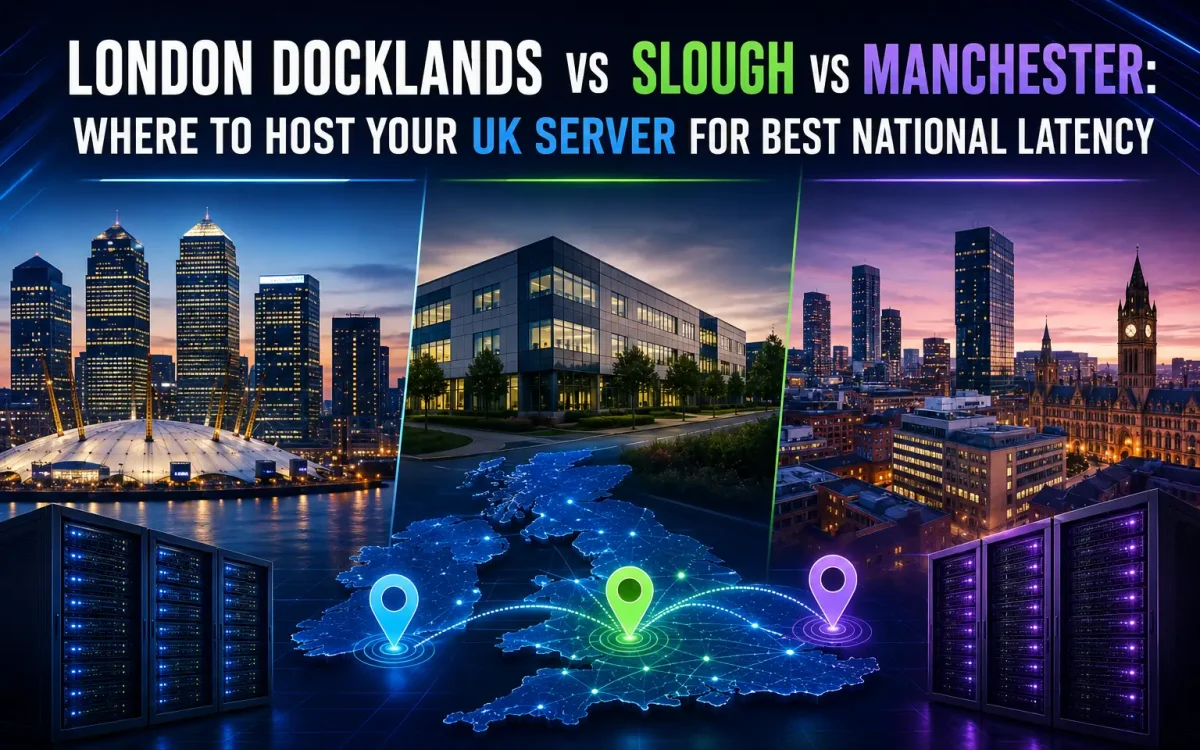
Three hosting hubs dominate the UK market: London Docklands, Slough, and Manchester. Each offers a distinct mix of connectivity, carrier diversity, cost, and national reach. This guide compares all three head-to-head — with real-world latency numbers, decision frameworks, and recommendations for different business types.
Why Server Location Still Matters in 2026
Even with modern fibre networks, physical distance still drives network latency. Every visitor request traverses local ISPs, regional carriers, Internet exchanges, and upstream providers before reaching your server. Each hop adds milliseconds — and the cumulative effect determines how fast (or slow) your site feels.
Lower latency means faster page loads, better application responsiveness, snappier API calls, lower gaming latency, and stronger Core Web Vitals scores (which Google uses as a direct ranking signal). For businesses serving customers across the UK, hosting location is one of the highest-leverage performance decisions you’ll make.
Hosting in London Docklands
London Docklands remains the largest and most important connectivity hub in the United Kingdom. The area concentrates the highest density of Internet exchanges (including LINX and LONAP), carrier-neutral facilities, global cloud provider PoPs, and international transit providers anywhere in Britain.
Strengths
- Exceptional carrier diversity — hundreds of networks present in single buildings (Telehouse North, Equinix LD8, LD5)
- Lowest international latency — direct paths to Europe, US East Coast, and Middle East
- Major Internet exchanges — LINX, LONAP, and IX Reach all operate here
- Mature cloud ecosystem — AWS, Azure, GCP, OCI all have edge/regional infrastructure
- Financial-sector-grade latency — proximity to London Stock Exchange matching engines
Trade-offs
- Highest hosting and colocation costs in the UK
- Space constraints — many Docklands campuses are at capacity
- Power pricing reflects London commercial rates
Hosting in Slough for Enterprise Scale
Slough sits roughly 30 kilometres west of central London, just outside the M25. Its trading estates have become Europe’s largest concentration of enterprise data centres — Equinix LD4 and LD5, Virtus, Iron Mountain, Ark, NTT, and many others operate massive campuses here.
Why Slough is so popular
- Near-Docklands latency — typically 1-2 ms additional vs central London
- Massive, modern campuses — space for large-scale deployment, easier expansion
- Better power pricing — outside London’s commercial premium
- Excellent carrier connectivity — most Tier-1 networks present, dark fibre back to Docklands
- Cloud on-ramps — Azure ExpressRoute, AWS Direct Connect, GCP Interconnect all available
For most UK businesses, Slough delivers ~98% of Docklands’ network performance at materially lower cost. It’s the sweet spot for SaaS, enterprise hosting, and scale-out cloud deployments.
Hosting in Manchester for Northern Coverage
Manchester has grown into the UK’s most credible alternative to London-area hosting. Equinix MA3 and MA4, Telehouse, and several independent operators run facilities here, with the LINX-operated IX Manchester providing peering directly within the city.
- Materially lower latency to Northern England, Scotland, and Northern Ireland
- Strong regional carrier presence and growing international transit
- Lower colocation pricing than London/Slough
- Geographic redundancy — natural DR pair for a London/Slough primary site
- Growing AI/ML and GPU hosting capacity
How London Docklands vs Slough Differ on UK Latency
The numbers below reflect typical end-user latency (in milliseconds) from each data centre to major UK cities on residential broadband — based on published RIPE Atlas and Cloudflare Radar measurements.
The key takeaway: no single UK location dominates nationwide. Docklands and Slough are essentially tied for southern England (1-2 ms apart). Manchester opens a clear gap of 6-7 ms over both for Edinburgh, Glasgow, and the rest of the north — meaningful for latency-sensitive workloads.
How BGP Routing Affects Hosting Performance
Geography sets the lower bound, but actual end-user latency depends on routing — specifically how your hosting provider’s BGP peering interacts with the visitor’s ISP. A Manchester data centre with poor peering can be slower to Manchester users than a well-peered Docklands facility.
This is why hosting providers with multiple Tier-1 transits and rich IXP peering typically outperform competitors hosted in the same building. For a deeper dive, see our guide to BGP routing and its impact on hosting performance.
Best Location for Different Workloads
How International Traffic Reaches UK Servers
- London Docklands — gateway to Europe, US East Coast, and the Middle East. Sub-millisecond paths to all major European IXPs (AMS-IX, DE-CIX, FRA). Lowest-latency option for non-UK audiences.
- Slough — same international reach as Docklands via dark fibre, with a +1-2 ms penalty. Typically the better cost/performance balance for global SaaS.
- Manchester — strong UK and Ireland connectivity, growing transit options, but materially slower paths to the US, Asia, and Africa.
For sites that serve audiences both in the UK and abroad, a London-area location is usually the better default — paired with a CDN for outlying regions. See our deeper analysis of UK datacentre location and SEO impact.
Deploy Across Two UK Regions for Redundancy
For applications where uptime, geographic redundancy, or regional latency matter, the strongest setup is rarely a single data centre — it’s a paired deployment across two of these three hubs.
- London Docklands + Manchester — maximum geographic separation, ideal for DR and dual-active deployments. Latency to north + south optimised.
- Slough + Manchester — slightly cheaper than Docklands + MA, with very similar performance characteristics.
- Docklands + Slough — high-availability inside the London region; not true geographic DR (shared power grid, shared flood risk).
For practical guidance on architecting across UK regions, see our walkthrough on multi-region cloud hosting for sub-50ms latency.
Final Verdict
- Choose London Docklands if you need the absolute lowest international latency, financial-grade peering, or your audience is concentrated in London and the South East.
- Choose Slough if you want London-equivalent performance at lower cost — the best default for most UK SaaS and enterprise workloads.
- Choose Manchester if your audience skews Northern English, Scottish, Welsh, or Northern Irish — or as the DR pair for a London-area primary site.
Conclusion
There’s no single “best” UK data centre location — only the best one for your users. Docklands wins the south and international, Manchester wins the north, and Slough offers the best price-performance balance for the majority of British workloads. The smartest UK hosting strategies pair two of these three locations to cover both north and south at sub-15 ms latency for almost the entire country.
UK Speed Hosts Across All Three UK Hubs
Whether you need Docklands-grade international reach, Slough cost-efficiency, or Manchester northern coverage — UK Speed runs NVMe-backed infrastructure with rich BGP peering across all three regions.
Explore UK Speed Hosting →

