Introduction
Containerization has completely transformed how modern applications are deployed, managed, and scaled. Whether you’re running SaaS platforms, web applications, APIs, AI workloads, microservices, or enterprise software, containers provide a consistent and efficient way to package and deploy applications across different environments. However, running a few containers is easy. Managing dozens, hundreds, or even thousands of containers requires an orchestration platform capable of handling scheduling, networking, scaling, updates, monitoring, and recovery automatically. For years, two major self-hosted orchestration solutions have dominated discussions: Kubernetes and Docker Swarm.
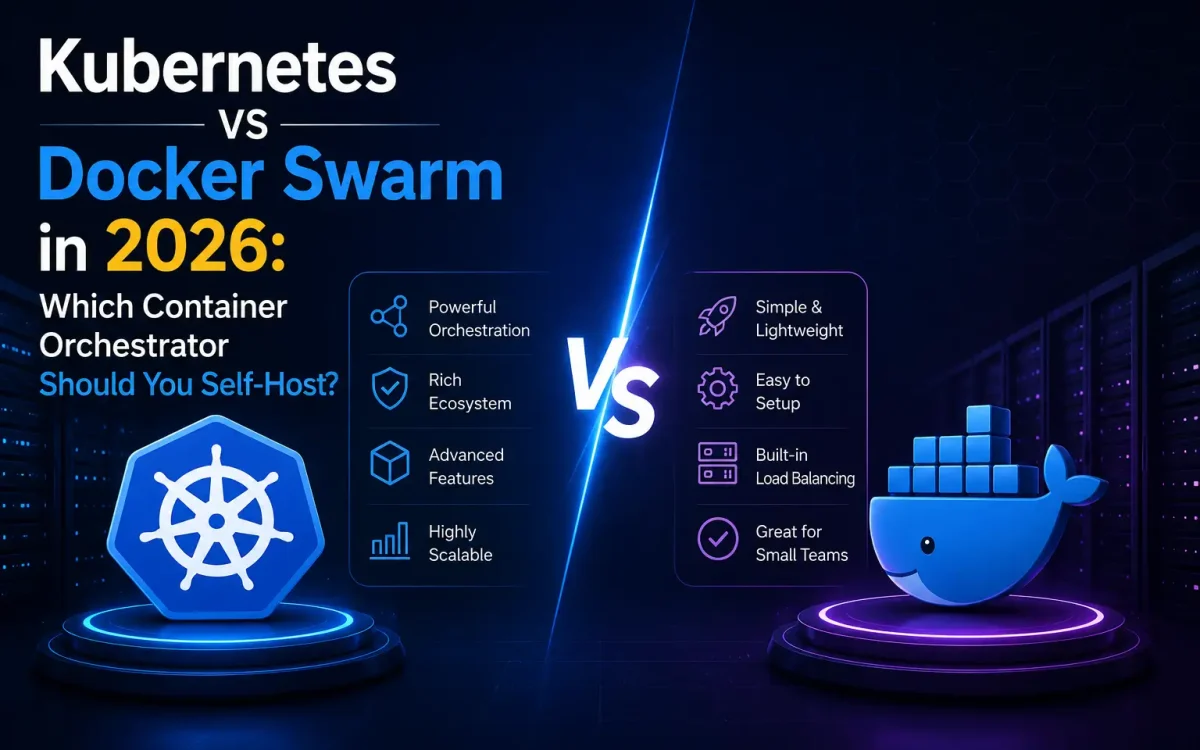
While Kubernetes has become the industry standard for large-scale deployments, Docker Swarm remains popular among developers and small businesses looking for simplicity and faster deployment. In this comprehensive guide, we’ll compare Kubernetes and Docker Swarm in 2026, examine their strengths and weaknesses, and help you determine which container orchestrator is the right choice for your self-hosted infrastructure.
What Is Container Orchestration?
Container orchestration is the automated management of containerized applications. Instead of manually starting, stopping, and monitoring containers, an orchestrator handles:
- Container deployment
- Service discovery
- Load balancing
- Automatic scaling
- High availability
- Health monitoring
- Rolling updates
- Self-healing
- Resource scheduling
Without orchestration, managing production containers quickly becomes difficult as workloads grow.
What Is Kubernetes?
Kubernetes, often abbreviated as K8s, is an open-source container orchestration platform originally developed by Google and now maintained by the Cloud Native Computing Foundation (CNCF). It has become the dominant platform for managing containerized applications in cloud and on-premises environments. Kubernetes provides:
- Automated deployment
- Service discovery
- Load balancing
- Horizontal scaling
- Self-healing
- Secret management
- Storage orchestration
- Advanced networking
- Multi-node clustering
Today, Kubernetes powers infrastructure for startups, enterprises, cloud providers, SaaS companies, and large-scale platforms worldwide.
What Is Docker Swarm?
Docker Swarm is Docker’s native container orchestration platform. It allows multiple Docker hosts to work together as a single cluster while maintaining the familiar Docker experience developers already know. Docker Swarm offers:
- Simple cluster management
- Native Docker integration
- Load balancing
- Service replication
- Rolling updates
- Basic high availability
- Container scheduling
Swarm was designed to make container orchestration accessible without the complexity associated with Kubernetes.
Why Compare Kubernetes and Docker Swarm in 2026?
Although Kubernetes dominates enterprise deployments, Docker Swarm still remains relevant for:
- Small businesses
- Internal applications
- Development environments
- Lightweight self-hosted projects
- Teams with limited DevOps expertise
The question many VPS owners and self-hosting enthusiasts ask is: Should you deploy Kubernetes or Docker Swarm for your own infrastructure? The answer depends on your goals, workload size, operational experience, and future growth plans.
Architecture Comparison
Kubernetes Architecture
Kubernetes consists of multiple components: Control Plane:
- API Server
- Scheduler
- Controller Manager
- etcd Database
Worker Nodes:
- Kubelet
- Container Runtime
- Kube Proxy
This architecture provides tremendous flexibility but increases complexity.
Docker Swarm Architecture
Docker Swarm uses: Manager Nodes:
- Cluster management
- Scheduling
- State management
Worker Nodes:
- Run containers
- Execute assigned tasks
The architecture is considerably simpler and easier to understand.
Winner: Docker Swarm
For simplicity and ease of deployment, Docker Swarm has a clear advantage.
Installation Complexity
Kubernetes
Installing Kubernetes often requires:
- kubeadm
- K3s
- RKE2
- MicroK8s
- Talos Linux
Administrators must configure:
- Networking
- Storage classes
- Ingress controllers
- Certificates
- Monitoring systems
Learning curve: High.
Docker Swarm
Deployment requires only:
docker swarm init
Worker nodes can join using a single command. Learning curve: Low.
Winner: Docker Swarm
Swarm remains dramatically easier to deploy and manage.
Resource Consumption
Kubernetes
A Kubernetes control plane consumes significantly more resources. Typical requirements:
- 2–4 GB RAM minimum
- Multiple system services
- Additional networking layers
Production clusters often require larger VPS instances.
Docker Swarm
Swarm is lightweight. Typical requirements:
- 512 MB to 1 GB RAM
- Minimal background services
- Lower CPU overhead
Winner: Docker Swarm
Swarm remains the better choice for smaller VPS deployments.
Scalability
Kubernetes
Designed for:
- Hundreds of nodes
- Thousands of containers
- Enterprise workloads
- Global deployments
Scaling is highly automated.
Docker Swarm
Works well for:
- Small clusters
- Medium-sized deployments
- Internal services
Large-scale environments become more challenging.
Winner: Kubernetes
For serious scaling requirements, Kubernetes is unmatched.
High Availability
Kubernetes
Provides advanced self-healing features:
- Automatic restarts
- Health probes
- Pod replacement
- Node failure recovery
- Rolling deployments
Docker Swarm
Offers:
- Service replication
- Basic failover
- Rolling updates
However, recovery mechanisms are less sophisticated.
Winner: Kubernetes
Kubernetes delivers superior resilience.
Networking Capabilities
Kubernetes
Supports:
- CNI plugins
- Advanced routing
- Service meshes
- Network policies
- Multi-cluster networking
Popular integrations include:
- Calico
- Cilium
- Flannel
Docker Swarm
Provides:
- Overlay networking
- Service discovery
- Internal load balancing
Networking is simpler but less powerful.
Winner: Kubernetes
Networking flexibility is significantly better.
Storage Management
Kubernetes
Storage options include:
- Persistent Volumes
- CSI Drivers
- Dynamic provisioning
- Cloud storage integrations
Supports nearly every storage platform available.
Docker Swarm
Storage management is basic. Administrators typically configure:
- Bind mounts
- NFS shares
- External volumes
Winner: Kubernetes
Storage orchestration is far more advanced.
Security Comparison
Kubernetes
Includes:
- RBAC
- Pod security policies
- Network policies
- Secrets management
- Admission controllers
Fine-grained access control is a major strength.
Docker Swarm
Provides:
- TLS encryption
- Mutual authentication
- Secrets management
Security is good but less comprehensive.
Winner: Kubernetes
Enterprise security requirements strongly favor Kubernetes.
Monitoring and Observability
Kubernetes
Ecosystem includes:
- Prometheus
- Grafana
- Loki
- OpenTelemetry
- Jaeger
Extensive observability capabilities are available.
Docker Swarm
Monitoring often requires additional manual configuration. The ecosystem is considerably smaller.
Winner: Kubernetes
Monitoring and observability are more mature.
Community and Ecosystem
Kubernetes
Benefits from:
- Massive community support
- Enterprise adoption
- Frequent updates
- Thousands of integrations
Supported by:
- Microsoft
- Amazon
- Red Hat
- VMware
Docker Swarm
Community activity remains smaller. Fewer third-party integrations exist.
Winner: Kubernetes
The ecosystem advantage is enormous.
Performance Comparison
For small deployments: Docker Swarm often delivers:
- Faster deployment times
- Lower resource overhead
- Simpler networking
- Reduced complexity
For large deployments: Kubernetes provides:
- Better scaling
- Better automation
- Better workload distribution
- Better resilience
Performance depends heavily on workload size.
Best Use Cases for Docker Swarm
Docker Swarm is ideal for:
- Personal projects
- Self-hosted services
- Development environments
- Small SaaS applications
- Internal business tools
- Lightweight VPS servers
Choose Swarm if:
- You want simplicity.
- You manage a small team.
- You have limited DevOps experience.
- You need fast deployment.
Best Use Cases for Kubernetes
Kubernetes is ideal for:
- Enterprise workloads
- Multi-service architectures
- High-traffic applications
- SaaS platforms
- AI infrastructure
- Large development teams
- Multi-region deployments
Choose Kubernetes if:
- You expect rapid growth.
- You need automation.
- You require advanced networking.
- You operate mission-critical applications.
Self-Hosting Considerations
Before choosing an orchestrator, evaluate:
VPS Resources
Small VPS:
- Docker Swarm
Large VPS Cluster:
- Kubernetes
Team Experience
Beginners:
- Docker Swarm
Experienced DevOps Teams:
- Kubernetes
Future Growth
Stable Workloads:
- Docker Swarm
Rapidly Growing Applications:
- Kubernetes
Maintenance Effort
Low Maintenance:
- Docker Swarm
Advanced Automation:
- Kubernetes
Kubernetes vs Docker Swarm: Comparison Table
| Feature | Kubernetes | Docker Swarm |
|---|---|---|
| Installation | Complex | Easy |
| Learning Curve | High | Low |
| Resource Usage | Higher | Lower |
| Scalability | Excellent | Good |
| Networking | Advanced | Basic |
| Storage | Advanced | Basic |
| Security | Enterprise Grade | Good |
| Monitoring | Excellent | Limited |
| Ecosystem | Massive | Smaller |
| Self-Healing | Advanced | Basic |
| Best for Enterprises | Yes | No |
| Best for Beginners | No | Yes |
Which One Should You Choose in 2026?
For most small businesses, developers, and self-hosting enthusiasts, Docker Swarm remains an excellent choice because of its simplicity, low resource requirements, and ease of management. However, if you’re building a serious SaaS platform, large-scale application infrastructure, AI platform, or enterprise environment, Kubernetes remains the undisputed leader. Kubernetes requires more effort to learn and manage, but its scalability, automation, and ecosystem justify the complexity for growing organizations.
Why VPS Infrastructure Matters for Container Orchestration
Regardless of whether you choose Kubernetes or Docker Swarm, the underlying infrastructure significantly impacts performance and reliability. A modern VPS environment should provide:
- Dedicated CPU resources
- Fast NVMe storage
- High network throughput
- Reliable uptime
- Flexible scaling options
High-performance VPS hosting allows orchestrators to deliver their full potential while ensuring stable application performance.
Conclusion
The Kubernetes vs Docker Swarm debate continues in 2026, but the answer depends entirely on your goals. Docker Swarm remains one of the easiest ways to deploy and manage containerized applications, making it perfect for self-hosting, small teams, and lightweight production workloads. Kubernetes, on the other hand, continues to dominate large-scale infrastructure thanks to its advanced automation, scalability, security features, and enormous ecosystem.
If simplicity is your priority, Docker Swarm is likely the better option. If long-term scalability and enterprise-grade orchestration are essential, Kubernetes remains the platform to beat. By evaluating your infrastructure requirements, team expertise, and future growth plans, you can confidently choose the orchestration platform that best fits your self-hosted environment in 2026.
Looking for fast, secure hosting?
Visit UK Speed for cloud servers, VPS NVMe, and dedicated hosting tailored for performance.
Further Reading
For an authoritative reference on this topic, see Docker Documentation.