Choosing between cloud hosting and VPS hosting is one of the most important decisions businesses, developers, and website owners face in 2026. Both solutions offer far more performance and flexibility than shared hosting, but each serves different needs.
If you are launching a business website, scaling an eCommerce store, hosting applications, or moving away from shared hosting, understanding the difference between cloud hosting and VPS hosting can help you make the right long-term decision.
In this detailed guide, we compare cloud hosting vs VPS hosting in performance, scalability, reliability, security, pricing, and real-world use cases to help you choose the best hosting solution.
What Is VPS Hosting
VPS hosting stands for Virtual Private Server hosting.
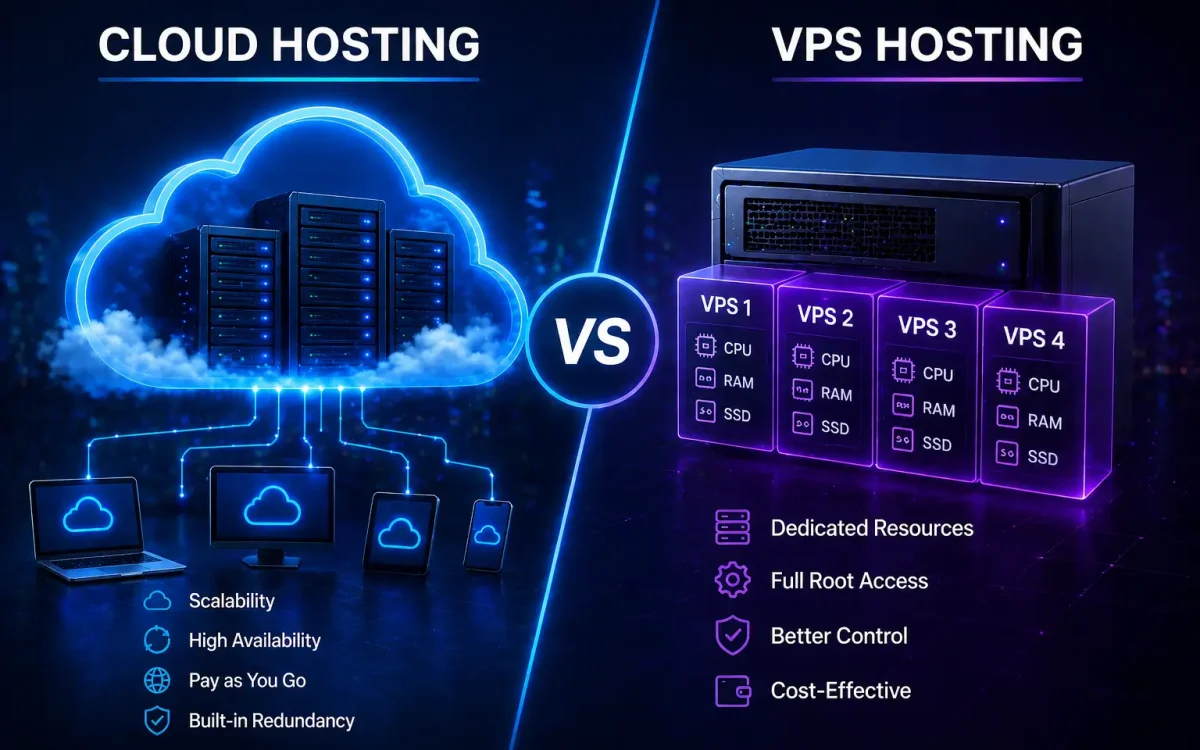
A VPS is created by dividing a physical server into multiple isolated virtual servers through virtualization technology.
Each VPS receives dedicated resources such as:
- CPU cores
- RAM
- Storage
- Operating system
- Root access
Although multiple VPS instances may share the same hardware, every virtual server functions independently.
VPS hosting sits between shared hosting and dedicated servers.
It offers greater performance, control, and flexibility without the higher cost of dedicated infrastructure.
It is commonly used for:
- Business websites
- WordPress hosting
- Development environments
- Web applications
- Growing online stores
What Is Cloud Hosting
Cloud hosting uses a network of connected servers rather than relying on one physical server.
Instead of running everything from a single machine, resources are distributed across multiple servers.
That means:
- Higher availability
- Flexible resource scaling
- Better redundancy
- Improved traffic handling
- Lower downtime risk
This distributed architecture is what makes cloud hosting powerful.
If one server experiences issues, another can often take over.
Cloud Hosting vs VPS Hosting Overview
At first glance, both can seem similar.
Both offer:
- Dedicated resources
- Better performance than shared hosting
- Greater control
- Stronger security
- Scalability
But the underlying architecture is very different.
VPS Hosting
Typically based on:
- One physical server
- Multiple isolated virtual servers
- Fixed resource allocation
Cloud Hosting
Typically based on:
- Multi-server infrastructure
- Distributed resources
- Elastic resource pools
That difference impacts performance, scalability, uptime, and growth potential.
Key Differences Between Cloud Hosting and VPS
| Feature | VPS Hosting | Cloud Hosting |
|---|---|---|
| Infrastructure | Single server | Multiple servers |
| Resource Scaling | Limited | Elastic |
| Uptime | High | Very High |
| Failover | Limited | Advanced |
| Redundancy | Moderate | Strong |
| Traffic Handling | Good | Excellent |
| Flexibility | High | Very High |
| Pricing | Lower | Variable |
Performance Comparison
Performance often depends on hardware and optimization, but there are clear differences.
VPS Performance
A well-built VPS can deliver outstanding performance.
Especially with:
- NVMe storage
- Modern CPUs
- LiteSpeed web server
- Optimized caching
- High-speed networking
For many websites, a high-performance VPS is more than enough.
Ideal for:
- Company websites
- Blogs
- Medium traffic stores
- Custom applications
Cloud Hosting Performance
Cloud hosting often performs best under dynamic workloads.
Benefits may include:
- Distributed processing
- Load balancing
- Auto scaling
- High I/O performance
- Traffic spike handling
For variable or high-demand workloads, cloud often has the edge.
Performance Verdict
Stable workloads:
VPS can be excellent.
Growing or unpredictable workloads:
Cloud often wins.
Scalability Comparison
This is where cloud hosting usually stands out.
VPS Scalability
Scaling a VPS often means:
- Upgrading resources manually
- Moving to a larger plan
- Server migrations in some cases
It works well, but scaling can have limits.
Cloud Scalability
Cloud hosting often allows:
- On-demand resource increases
- Horizontal scaling
- Auto scaling
- Elastic infrastructure growth
That flexibility is one of its biggest strengths.
Scalability Winner
Cloud hosting.
Clearly.
Reliability and Uptime
VPS Reliability
VPS hosting is reliable, but often tied to one physical machine.
If underlying hardware fails, risk exists.
Cloud Reliability
Cloud environments often include:
- Failover systems
- Redundant nodes
- Replication
- High availability clusters
If one node has problems, workloads can shift elsewhere.
Uptime Winner
Cloud hosting.
Especially for mission-critical workloads.
Security Comparison
Both solutions can be secure.
But they differ.
VPS Security
Strong security potential with:
- Isolated environments
- Root-level controls
- Firewalls
- Custom hardening
- Access restrictions
Excellent when managed properly.
Cloud Security
Cloud platforms often include:
- Network segmentation
- Distributed protection
- Backup replication
- Advanced monitoring
- DDoS mitigation
- High availability security models
Can offer additional resilience.
Security Verdict
Both can be highly secure.
Enterprise-grade cloud may have an advantage.
Pricing Comparison
Pricing varies by provider.
VPS Pricing
Often more affordable.
Benefits include:
- Predictable monthly costs
- Great value
- Lower entry costs
Popular with:
- Startups
- Developers
- Small businesses
Cloud Hosting Pricing
Cloud pricing may be:
- Fixed plan based
- Usage based
- Pay as you grow
Can be highly efficient.
But costs may rise as resources scale.
Pricing Winner
Budget conscious users:
VPS.
Flexible scaling users:
Cloud may justify higher cost.
Best Use Cases for VPS Hosting
VPS is often ideal for:
Small Business Websites
Strong balance of performance and cost.
WordPress Hosting
Excellent for many WordPress sites.
Developers
Flexible and affordable.
Web Applications
Great for moderate workloads.
Agencies
Reliable hosting with full control.
Best Use Cases for Cloud Hosting
Cloud hosting often excels for:
High Traffic Websites
Handles demand spikes well.
eCommerce Stores
Especially during promotions and peak sales.
SaaS Platforms
Designed for scaling applications.
Enterprise Workloads
Strong for mission-critical infrastructure.
Rapid Growth Projects
Ideal when future growth matters.
When to Choose VPS Hosting
Choose VPS hosting if you need:
- Lower costs
- Dedicated resources
- Full control
- Stable traffic
- Strong performance
- Simpler infrastructure
VPS often makes sense when:
Your workload is predictable
You want value
You need root access
When to Choose Cloud Hosting
Choose cloud hosting if you need:
- High availability
- Elastic scaling
- Better redundancy
- Traffic spike protection
- Infrastructure built for growth
Cloud often makes sense when:
Uptime matters greatly
Traffic fluctuates
Growth is a priority
Cloud Hosting vs VPS Pros and Cons
VPS Hosting Pros
- Affordable
- Fast performance
- Full server control
- Predictable pricing
- Great shared hosting upgrade
VPS Hosting Cons
- Limited elasticity
- Lower redundancy
- Single server dependency
- Hardware risks
Cloud Hosting Pros
- Excellent scalability
- High uptime
- Strong redundancy
- Better traffic handling
- Flexible infrastructure
Cloud Hosting Cons
- Can cost more
- More complex environments
- Pricing can vary
Common Myths
Cloud Hosting Is Always Better
Not true.
Many websites perform perfectly on VPS.
VPS Cannot Scale
False.
It scales.
Just not as elastically.
Cloud Is Only for Enterprises
Incorrect.
Many small businesses use cloud hosting.
VPS Is Outdated
Completely false.
VPS remains highly relevant in 2026.
Decision Framework
Choose VPS if you prioritize:
- Value
- Control
- Simplicity
- Predictable workloads
Choose cloud if you prioritize:
- Growth
- High availability
- Elastic scaling
- Heavy traffic resilience
That is usually the real difference.
class=”uks-auto-extlink”>Further Reading
For an authoritative reference on this topic, see Cloudflare Learning — What Is Cloud Computing.